Fuel costs have always been part of the ownership experience, but in 2026, they’re hitting harder than ever for American drivers.
To understand where gas anxiety is peaking, American Muscle analyzed search trends nationwide and surveyed over 1,000 car owners. Rising prices are changing the way drivers think, spend, and hit the road.
Key Takeaways
- The states with the highest gas price anxiety are Nevada, Colorado, and California, based on per capita online searches.
- The cities with the highest gas price anxiety are Las Vegas, Cleveland, and Cincinnati, based on per capita online searches.
- 96% of American car owners say gas prices are a financial burden in 2026.
- 9 in 10 American car owners blame global oil supply disruptions for rising gas prices.
- 69% have cut back their driving due to gas prices, and nearly half have trimmed spending on travel, dining out, or non-essential shopping.
Where Gas Anxiety Runs Highest
Gas price anxiety varies widely across the country, based on how often people search online for terms like "cheap gas" and "gas prices." Nevada leads the nation, with 5,179 gas-related searches per capita, followed by Colorado, California, Oregon, and Washington.
A City-by-City Gas Anxiety Breakdown
Among the 99 most populous U.S. cities in our study, people in Las Vegas, Nevada, have the most gas price anxiety based on per capita online searches. They are followed by those in Cleveland and Cincinnati, Ohio. Denver and Orlando round out the top 5.
Green Vehicle Interest
- Interest in EVs and hybrids also varies by state, based on per capita online searches. North Dakota ranks No. 1, followed by California, West Virginia, Delaware, and New York.
- North Dakota stands out in particular, ranking near the bottom for gas anxiety (48th) despite leading in EV and hybrid interest (1st).
- The top 5 cities with the highest per capita interest in EVs and hybrids include Atlanta, Orlando, Cleveland, Miami, and Denver.
The Burden at the Pump
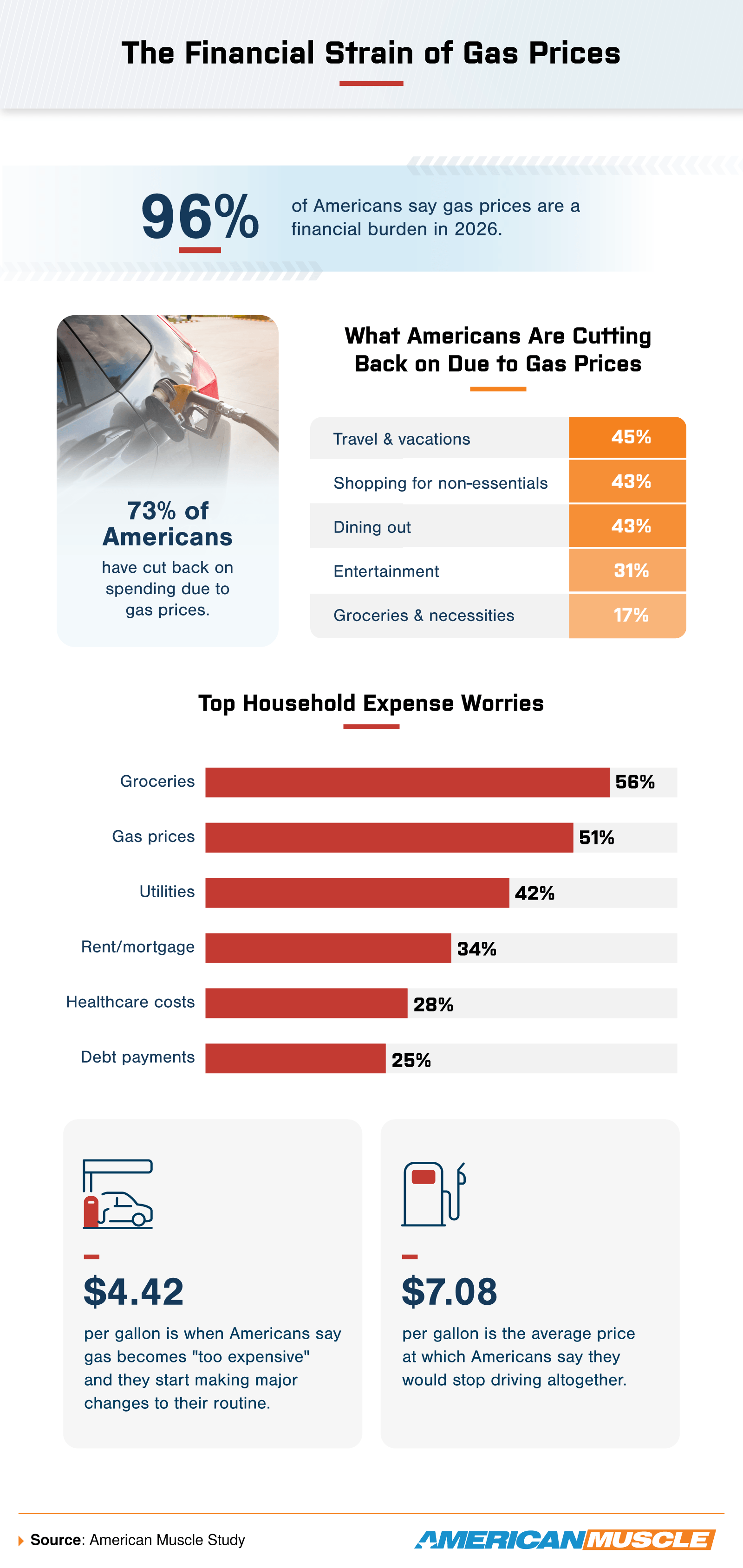
- 96% of American car owners say gas prices are a financial burden in 2026. Gen Z is the most likely to say so (98%), followed closely by millennials (97%). Baby boomers are the least likely, though still at 93%.
- Among Americans who have cut back on spending due to gas prices, many have reduced vacation travel (45%), non-essential shopping (43%), and dining out (43%). Millennials are the most likely generation to cut dining out (45%), while Gen Z is the least likely (36%).
- Gen Z has the highest gas price threshold before making major changes to their routine ($4.46), while millennials have the lowest ($4.38).
- 6% of Americans drive to a different city just to find cheaper gas, traveling an average of 26 miles round-trip.
Gas Prices Changing How America Moves
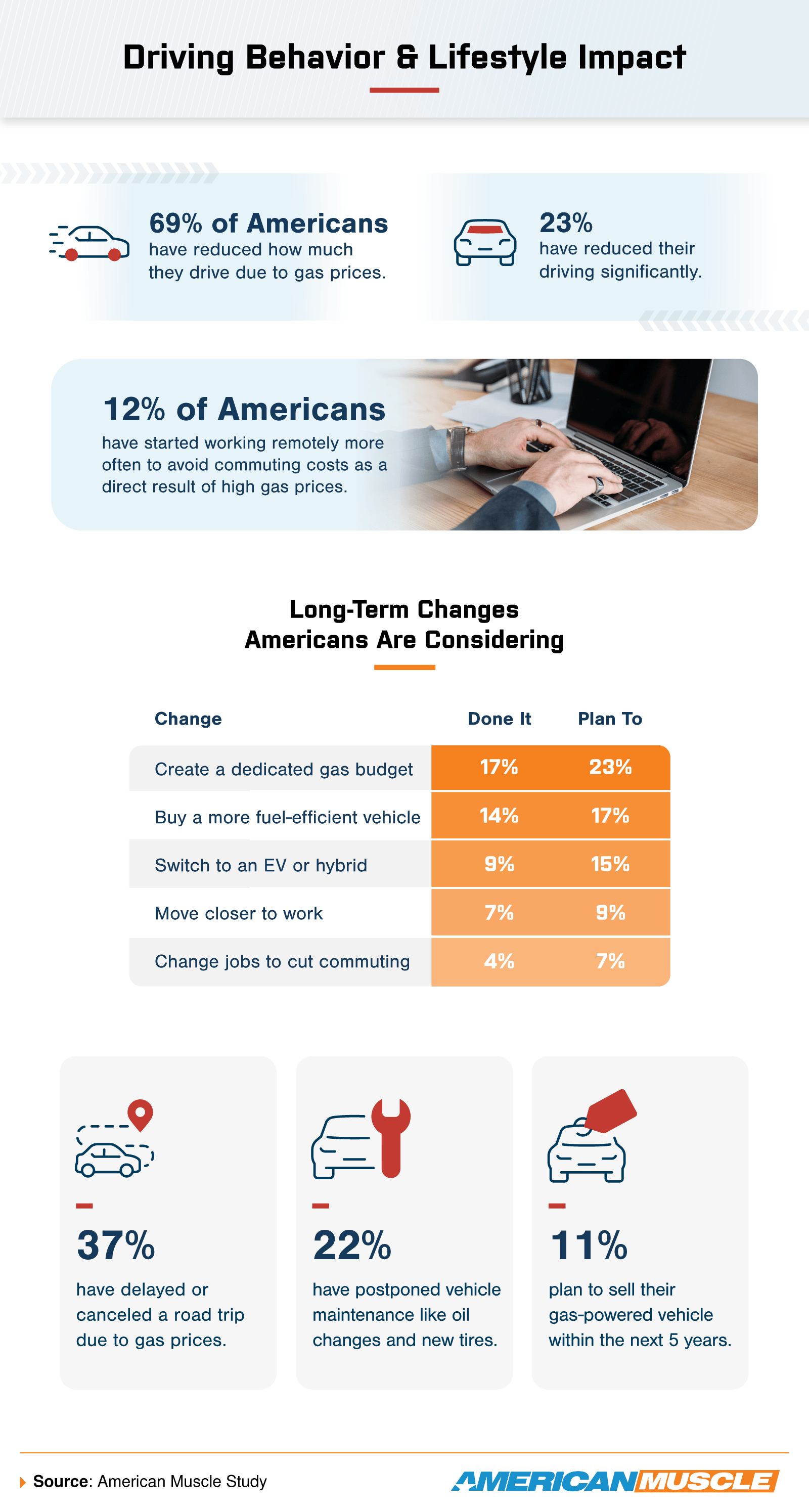
- 69% of American car owners have reduced their driving due to gas prices. Gen X (73%) and Gen Z (72%) are the most likely to have done so. Millennials are the least likely (66%).
- Gen X (41%) is the most likely to have canceled a road trip, followed by Gen Z (35%), millennials (36%), and baby boomers (33%).
- 12% of Americans have started working remotely more often. Gen Z is most likely to have done so (16%).
- 6% of Americans have looked for a job closer to home because of high gas prices. Gen Z is the most likely to have done so (12%).
- 9% of Americans have switched to an EV or hybrid vehicle due to gas prices. Millennials (11%) and Gen Z (10%) are the most likely to have done so.
- 15% of Americans plan to switch to an EV or hybrid vehicle due to gas prices, with Gen Z the most likely to say so (23%).
- Gen Z (17%) is the most likely to plan to sell their gas-powered vehicle in the next 5 years, compared to 10% of millennials, 12% of Gen X, and 8% of baby boomers.
Why Americans Think Gas Prices Are Up
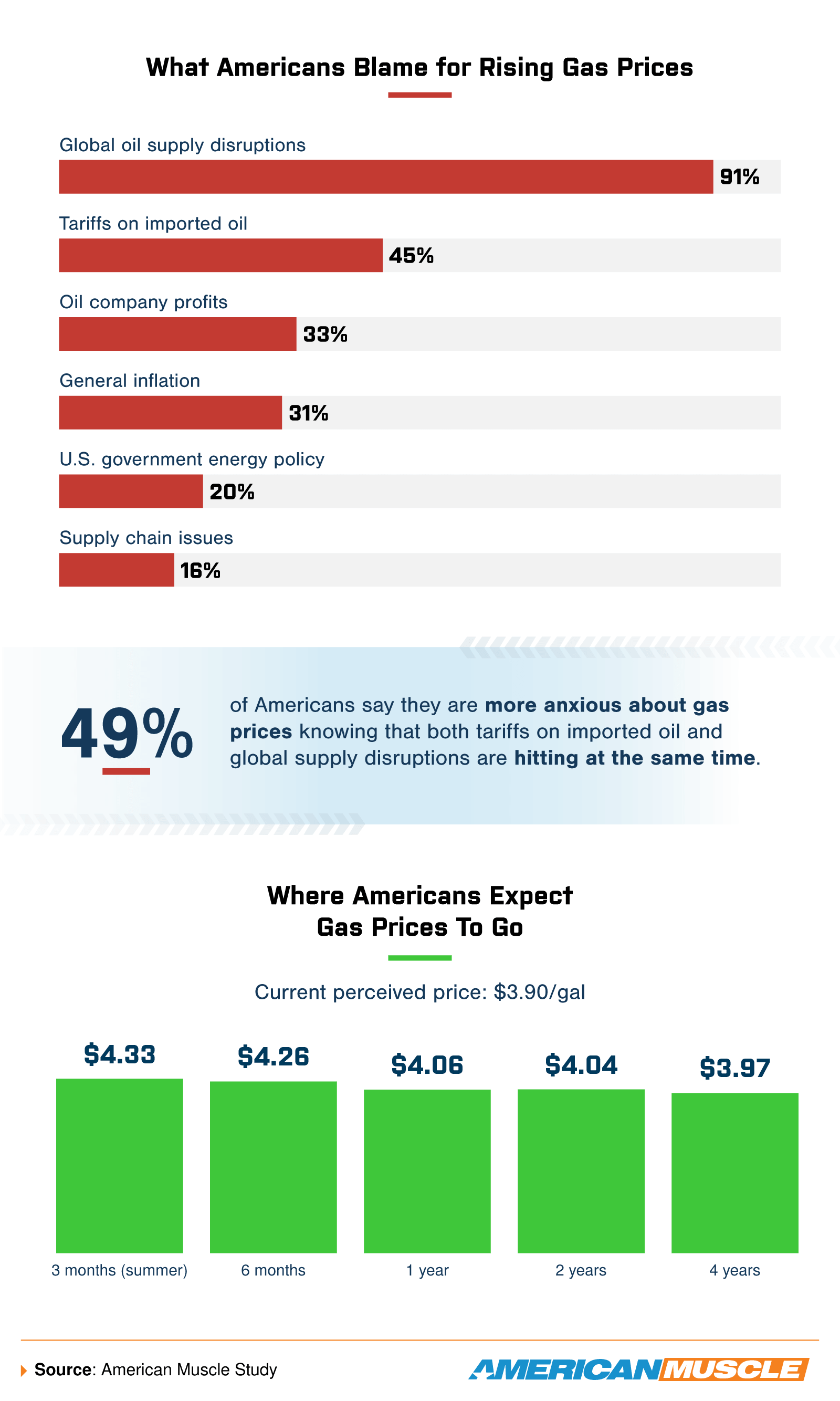
- 9 in 10 American car owners blame global oil supply disruptions for rising gas prices.
- Democrats (94%) are more likely than Republicans (87%) to blame disruptions to global oil supply for rising gas prices.
- Democrats (52%) are more likely than Republicans (31%) to blame tariffs on imported oil for rising gas prices.
Methodology
We analyzed keyword search volume data over the past year to identify which states and cities have the most gas price-related anxiety and interest in green vehicles. We specifically gathered monthly search volume for the terms "cheap gas," "cheap gas near me," "gas prices," "electric car," "electric vehicle," "hybrid car," and "hybrid vehicle" across all 50 U.S. states and the 99 most populous U.S. cities.
Additionally, we surveyed 1,073 Americans who own a car about their experiences with gas prices, spending behavior, and future expectations. Among respondents, 11% were baby boomers, 27% were Gen X, 51% were millennials, and 11% were Gen Z. Politically, 45% identified as Democrats, 30% as Independents, 21% as Republicans, and 4% had another or no political affiliation. Data was collected in March 2026.
About American Muscle
American Muscle supports muscle car enthusiasts with high-quality parts built for power and reliability. Whether you're chasing horsepower or throttle response, American Muscle carries performance intake systems for muscle cars engineered to help engines breathe better and perform stronger.
Fair Use Statement
This content is available for noncommercial sharing. When citing or republishing, please credit American Muscle and include a link to the original source.