 FREE 1 to 3-Day Delivery on Orders $149+ Details
The Parking Lot Pride Study: What Your Parking Habits Say About You

Every driver has a parking lot strategy, whether you've thought about it or not. To find out what's really going on when Americans pull into a lot, we surveyed 1,000 U.S. drivers who own e a personal vehicle, asking everything from where they choose to park to whether they've ever left a door ding and driven off. We've uncovered the unwritten rules, pet peeves, and guilty habits that play out in parking lots every day. If you've ever circled a lot three times to avoid a bad spot, you're in good company.
If you've ever circled a lot three times to avoid a bad spot, you're in good company.
Key Takeaways
- 79% of Americans judge how other people park.
- 74% of Americans deliberately avoid parking next to certain vehicles, with crooked parkers and trucks/SUVs topping the list.
- More than 2 in 5 Americans (41%) have experienced parking lot road rage in the past year; Nissan (50%) and Chevrolet (49%) drivers are the most likely to have been involved.
- 1 in 8 drivers admitted to door-dinging another car and driving away without a note in the past year; Kia drivers (20%) and Gen Z (18%) are the most likely to have done so.
- Avoiding high-traffic areas is the No. 1 factor influencing where Americans park (50%), edging out getting in and out quickly (47%) and door ding protection (45%).
Where You Park Says Everything
Your parking spot choice isn't random. It's a snapshot of your priorities, your patience level, and how much you care about your car.
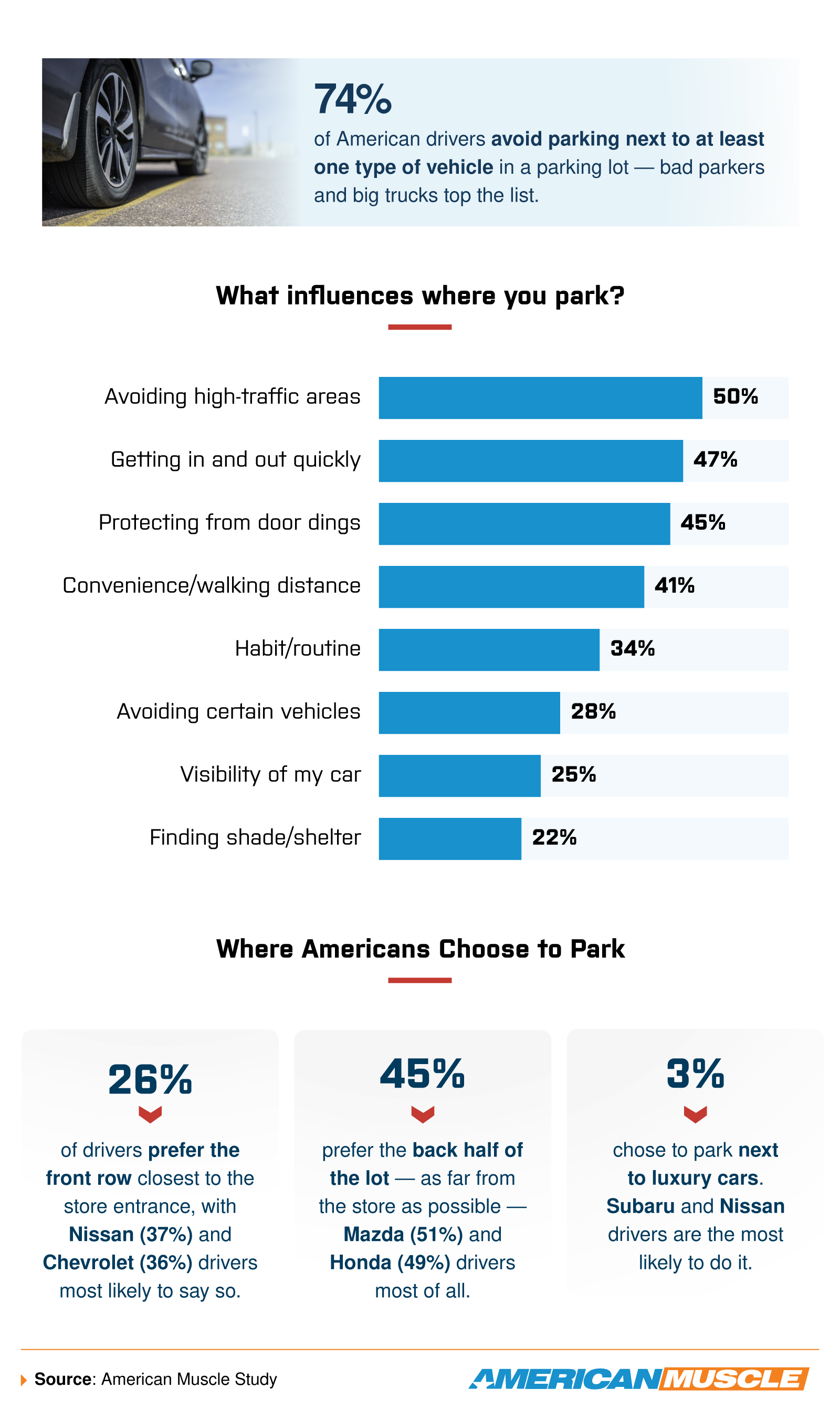
When shown a visual diagram of a moderately busy retail lot and asked where to park, 26% of drivers chose the front row closest to the store entrance. Nissan drivers led this trend at 37%, followed closely by Chevrolet drivers (36%). On the other hand, 45% of respondents said they prefer the back half of the lot, as far from the entrance as possible. Mazda (51%) and Honda (49%) drivers are the most committed to that strategy.
Avoiding high-traffic areas is the single biggest factor shaping where Americans park, with 50% citing it as a top influence. Getting in and out quickly came in second (47%), followed by door ding protection (45%). Just 3% of respondents said they'd actually choose to park next to a luxury car, whether that's a BMW, Porsche, or Bentley.
About 3 in 4 drivers (74%) said they actively avoid parking next to at least one type of vehicle. Crooked parkers top the list: 56% of respondents said they steer clear of anyone who's parked over the line. Trucks and SUVs came in second at 43%, and more than 1 in 5 drivers (22%) said they avoid cars with existing dents or damage. If you care about your paint, you're already doing the math every time you pull in.
The Parking Lot Psyche
There's a whole psychology happening between the lines, and most drivers won't admit to all of it.
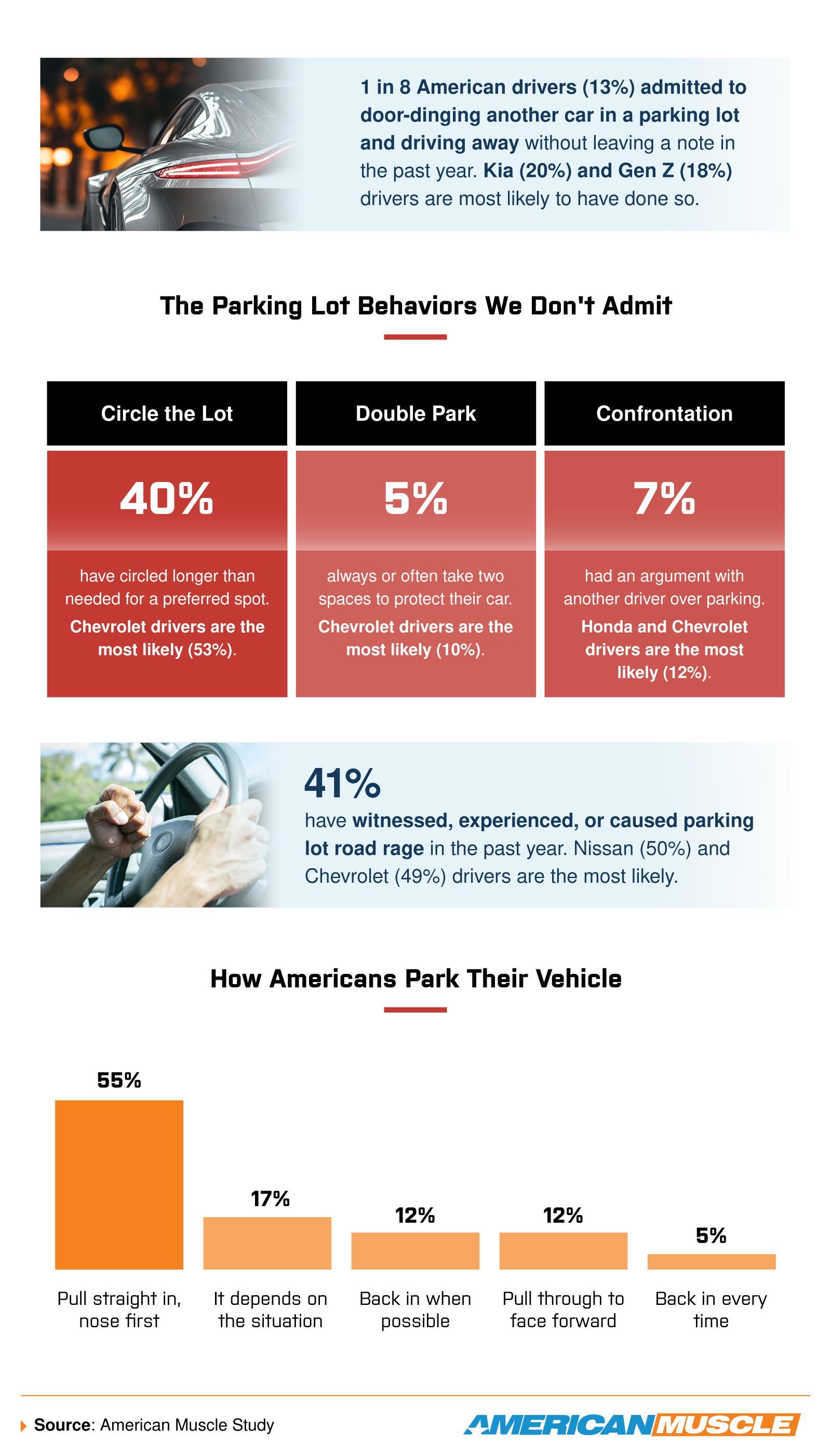
If you've ever come back to your car and found a fresh dent with no note, you know just how frustrating that can be. One in eight drivers admitted to door-dinging another car in a parking lot and just driving away in the past year. Kia drivers are the most likely to have done it (20%), and Gen Z leads all generations at 18%.
Another 40% of drivers have circled a lot longer than they needed to, just holding out for a better spot, with Chevrolet drivers doing so the most often (53%). A small but bold 5% regularly take up two spaces to protect their car, and again, Chevrolet drivers are most likely to do it (10%). Seven percent of drivers have actually gotten into an argument with another driver over a spot, with Honda and Chevrolet drivers most likely to escalate (12% each).
Parking lot road rage is pretty common. Over 2 in 5 drivers (41%) said they've witnessed, experienced, or caused it in the past year. Nissan drivers are most likely to have been involved (50%), followed closely by Chevrolet (49%). Gen Z is the generation most likely to have taken things to a confrontation (11%).
As for how people actually park, most drivers (55%) just pull straight in nose-first. Seventeen percent said it depends on the situation, 12% back in when they can, and 12% pull through to face forward. Only 5% back in every single time. Whatever your method, know that someone is probably judging you for it: 79% of Americans admit they have opinions about how others park, with Gen Z the most critical (81%).
How It All Adds Up
The parking lot is one of those places where everyone has an opinion, and nobody follows a rulebook, yet the data shows that most drivers are making the same calculated moves. Three-quarters of Americans are actively avoiding other vehicles, nearly half are optimizing for a quick exit, and a surprising number are circling for the perfect spot rather than just taking what's available. If you take pride in your vehicle, the parking lot is where that shows, and based on this survey, most people are paying closer attention than you might think.