The Dying Art: Who's Still Driving Stick
Learning to drive a stick shift once happened out of necessity. The skill now often reflects a decision to connect more deeply with driving culture and automotive enthusiasm.
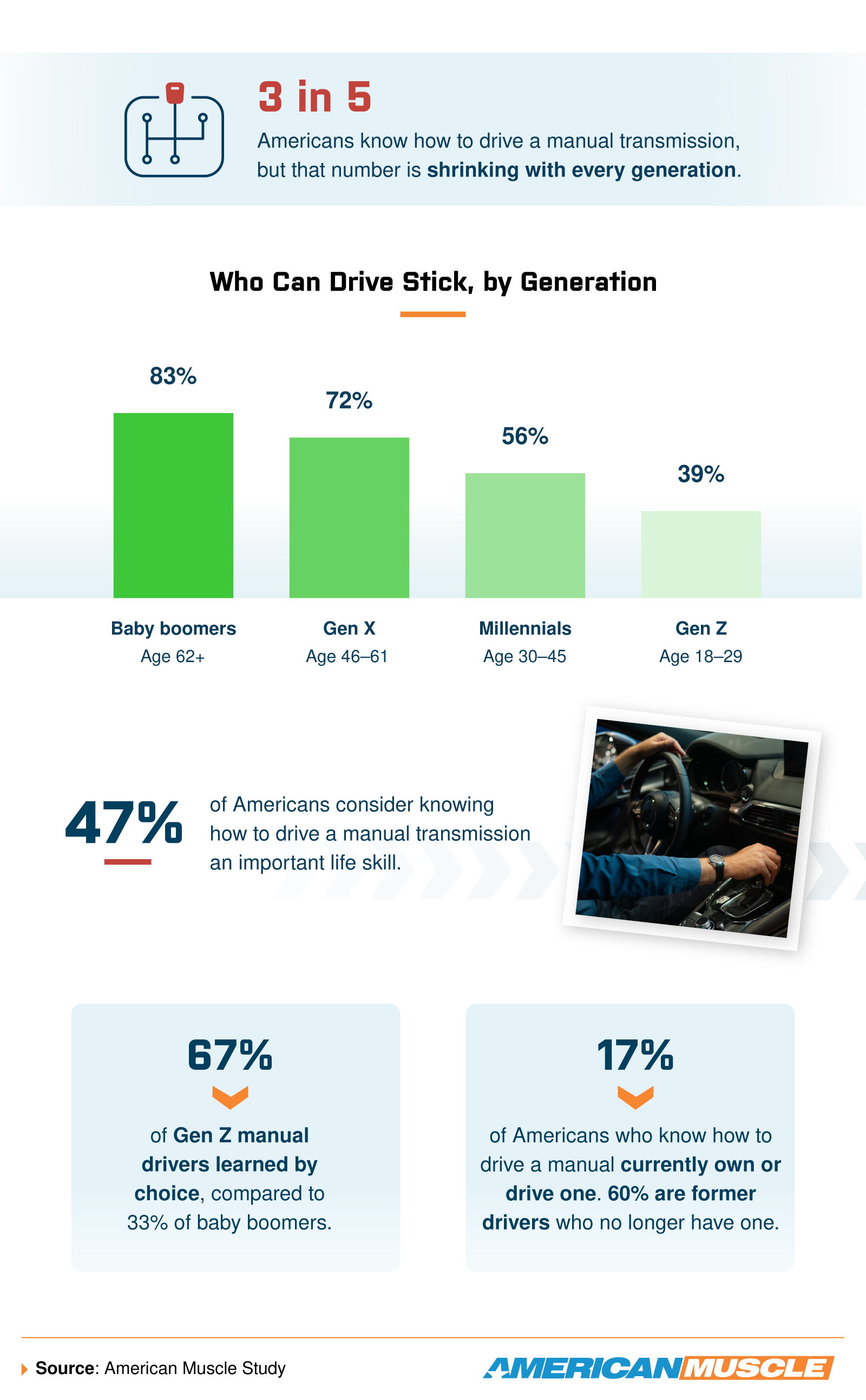
While 83% of baby boomers know how to drive stick, that drops to just 39% among Gen Z. Baby boomers were also the most likely generation to believe everyone should know how to drive a manual (30%). Just 16% of Gen Z agreed.
How people learned to drive a manual car:
- Parent or family member (64%)
- Friend (20%)
- Self-taught (10%)
The family tradition may be fading, though, as 43% of manual drivers said they aren't currently teaching anyone else the skill. Among Gen Z drivers who know how to drive stick, 67% learned by choice, compared to 33% of baby boomers, who mostly learned out of necessity. Nearly half of Gen Z manual drivers (48%) learned without having regular access to a manual vehicle.
Despite widespread familiarity with manual transmissions, ownership remains rare. Among Americans who know how to drive stick, just 17% currently own or regularly drive one. Americans were divided on whether manual driving is still important: 47% called it a valuable life skill, while 46% said it's becoming irrelevant.
Additional demographic findings revealed:
- Men were more likely than women to know how to drive stick (72% vs. 53%).
- Women were more likely than men to find the skill attractive in others (21% vs. 15%).
The Last Survivors: Manual Transmission Market Snapshot
The manual transmission market has shrunk dramatically, leaving enthusiasts with fewer choices than ever before. Even so, a handful of models continue carrying the torch.
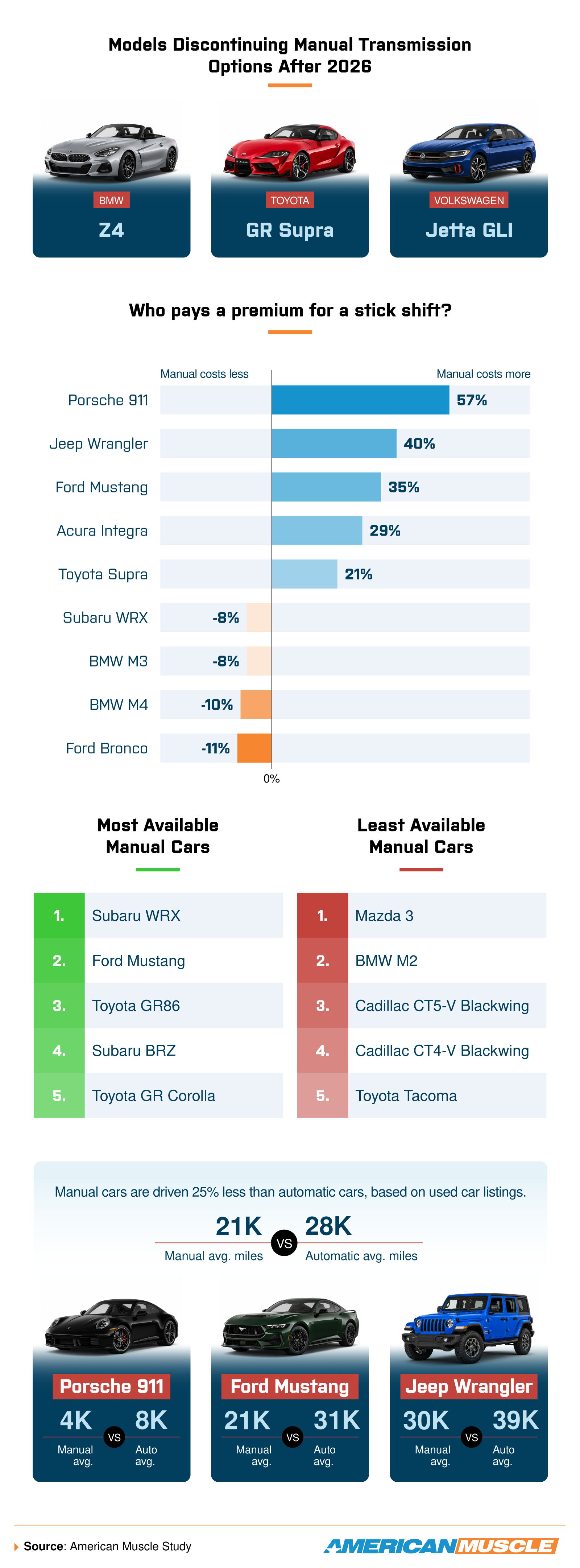
Only 24 vehicle models in the entire U.S. new-car market still offer a manual transmission option in 2026. Subaru and Toyota account for nearly half of all manual listings nationwide, making them the biggest contributors to the remaining stick-shift market.
The Subaru WRX led all models with an 83% manual share of total listing inventory. Unlike many enthusiast vehicles, the WRX's manual version actually trades for 8% less than its automatic version on the used market.
The Ford Mustang remains one of the most significant manual-transmission vehicles in America. It accounts for 10% of all manual listings nationwide and commands a 35% premium over comparable automatic-equipped Mustangs on the used market.
Manual availability is becoming increasingly limited on the used market, with just three active models available across 30 or more states:
- Subaru WRX (35 states)
- Toyota GR86 (32 states)
- Toyota GR Corolla (32 states)
Meanwhile, several active manual models were found in 10 states or fewer:
- BMW M2 (8 states)
- BMW M3 (10 states)
- Cadillac CT4-V Blackwing (8 states)
- Cadillac CT5-V Blackwing (9 states)
- Mazda3 (5 states)
- Toyota Tacoma (10 states)
Rarity also drove premiums higher at the top of the market. The Porsche 911 was the only vehicle where manual listings outnumbered automatics, and buyers paid a 57% premium for that distinction. Across the used market, manual-equipped vehicles had accumulated around 25% fewer miles on average than automatics, suggesting many are being preserved as enthusiast cars.
Several notable manuals are nearing the end of the road. The 2026 Volkswagen Jetta GLI marks the final manual Volkswagen available in the United States, while the BMW Z4 and Toyota GR Supra manual variants are both scheduled to disappear after 2026.
Stick Shift or Stick Around: What Manual Drivers Will Pay, Sacrifice, and Predict
For enthusiasts who prefer manuals, the appeal goes far beyond practicality. Their buying decisions reveal just how much value they place on engagement, control, and preserving a driving experience that many fear is disappearing.
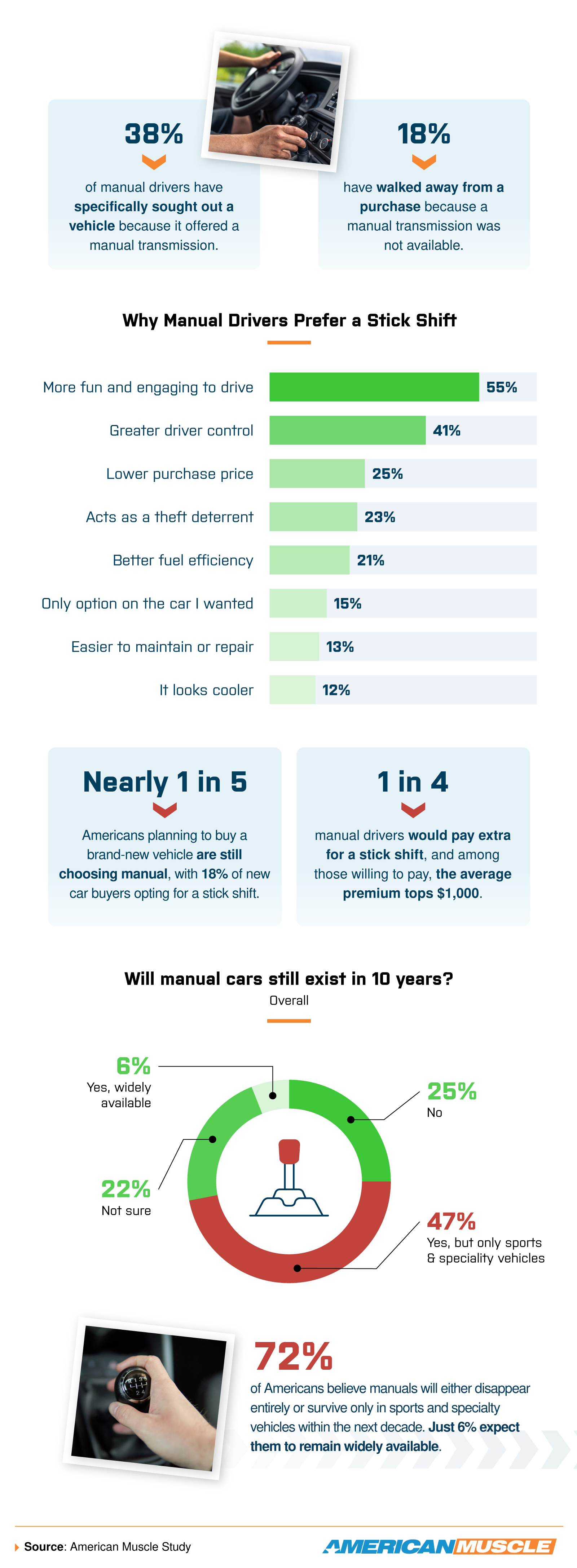
Fun and engagement are the top reasons why drivers prefer a manual transmission, cited by 55% of respondents. Driver control followed at 41%, while cost savings (25%) and fuel efficiency (21%) ranked lower. Another 23% said they preferred manuals because they serve as a theft deterrent.
That enthusiasm often comes with a willingness to spend more. One-quarter of manual drivers said they would pay a premium for a stick shift. Among those willing to pay extra, the average premium exceeded $1,000. Gen Z showed the strongest willingness to pay more for a manual (18%), while baby boomers were the least willing (11%).
Manual enthusiasts are making significant sacrifices to get the vehicles they want:
- 38% of manual drivers have specifically sought out a vehicle because it offered a manual.
- 18% of manual drivers have walked away from a purchase because a stick wasn't available.
- 5% of Americans would travel more than 250 miles or cross state lines to buy a manual.
- Millennials were the generation most willing to travel for a stick-shift vehicle (30%).
While manuals continue attracting a loyal audience, buyers recognize their future may be limited. Among Americans planning to buy a new vehicle, just 18% said they would choose a manual transmission.
Most Americans believe manuals will survive only as specialty vehicles. Nearly half (47%) said manuals will remain available primarily in sports cars and enthusiast-focused models over the next decade, while 25% believe they'll disappear entirely. Just 6% expected manuals to remain widely available. Gen Z was the most optimistic generation, with 55% believing manuals will continue to survive in performance vehicles, compared to 37% among baby boomers.
The Stick Shift Isn't Dead Yet
The manual transmission's role in the automotive world has clearly changed. What was once a common skill and everyday option has become a niche pursued by enthusiasts willing to pay more, travel farther, and hold onto their vehicles longer. While the number of available models continues to shrink, demand among dedicated drivers remains remarkably resilient. The future of the stick shift may not be mass-market, but as long as enthusiasts continue chasing engagement behind the wheel, the manual transmission still has a road ahead.
Methodology
Survey Methodology
An online survey of 997 U.S. adults was conducted in June 2026 via CloudResearch Connect and Prolific. Respondents answered questions covering manual transmission knowledge, personal experience, purchasing behavior, and attitudes toward the future of the stick shift. Age responses were grouped in generations as follows: Gen Z (18–29), millennials (30–45), Gen X (46–61), and baby boomers (62+). The sample was 57% women, 42% men, and 1% non-binary or unreported.
By generation, the breakdown was 46% millennials, 26% Gen X, 16% Gen Z, and 12% baby boomers. Household income was broadly distributed across all brackets. Questions on purchasing behavior and reasons for preferring manual were directed only at respondents who confirmed they can drive a manual transmission. Demographic subgroups representing fewer than 5% of the total sample were excluded from headline findings.
Marketplace Listing Data Methodology
Used-vehicle listings from CarGurus.com were collected in June 2026 via a commercial Apify scraping actor. Only public search result pages were accessed. The dataset covers 29 model lines that offered a manual transmission in model years 2021 to 2026, cross-referenced against current manufacturer specifications. Of these, 24 models were confirmed to still offer a manual transmission for the 2026 model year and form the basis of all model-level findings reported above. For each model, national, manual-filtered, and state-level searches were run across all 50 states.
Listings were deduplicated by VIN across all collection runs. Shells, salvage, and unavailable entries, and unrelated cross-references were removed. Make, model, trim, and transmission fields were normalized; transmission type was verified directly from each listing's own data field.
The final dataset contains 5,454 unique listings: 1,781 with a verified manual transmission and 3,130 automatic, across all 50 states. The 24 confirmed 2026 manual models account for 1,741 of those manual listings. Price and days-on-market figures are statistically reliable for models with 30 or more manual listings; lower-volume models should be treated as directional counts rather than precise averages. All data represents a point-in-time inventory snapshot from June 2026 and is not a registration or sales census.
About American Muscle
American Muscle supports muscle car enthusiasts with high-quality parts built for power and reliability. Whether you're chasing horsepower or throttle response, American Muscle carries performance intake systems for muscle cars engineered to help engines breathe better and perform stronger.
Fair Use Statement
The information and findings presented in this article may be shared for noncommercial purposes only. If you reference or republish this content, please provide proper attribution and include a link back to AmericanMuscle as the original source.