Ever push your Mustang hard into a corner and feel the rear end get unsettled, almost like it has a mind of its own? Or maybe you've noticed a subtle side-to-side shimmy over uneven pavement that no amount of sway bar adjustment seems to fix. That squirrelly rear-end sensation is often caused by how your axle is located laterally under the car, and swapping in a Watts link is one of the most effective ways to eliminate it.
In this guide, you'll learn exactly what a Watts link is, how it works at a mechanical level, how it compares to a traditional panhard bar, and whether it's the right upgrade for your Mustang build. If you're weighing your rear suspension options before a Mustang suspension overview overhaul, this is the place to start.
What Is a Watts Link?
![]() A Watts link (also called a Watts linkage) is a rear suspension component designed to keep a solid rear axle centered directly beneath the vehicle during suspension travel. It eliminates lateral axle movement so the rear end tracks straight up and down rather than shifting side to side.
A Watts link (also called a Watts linkage) is a rear suspension component designed to keep a solid rear axle centered directly beneath the vehicle during suspension travel. It eliminates lateral axle movement so the rear end tracks straight up and down rather than shifting side to side.
The concept was originally devised by Scottish inventor James Watt in the late 1700s as a mechanical linkage for steam engines, but the same geometry translates perfectly to automotive suspension. On a solid-axle car like a Mustang, the Watts link's job is lateral axle location — the control of where the rear axle sits from left to right under the chassis. Without it (or without an alternative like a panhard bar), your rear end would be free to shift laterally during cornering, braking, and bump travel, creating unpredictable handling.
The key distinction of a Watts link versus other lateral location methods is its symmetrical design. Because the linkage uses two equal-length arms and a central pivot mounted to the axle, the axle moves in a perfectly vertical line rather than along an arc. That means your Mustang handles identically in left and right turns, with no built-in bias from the suspension geometry.
How Does a Watts Link Work?
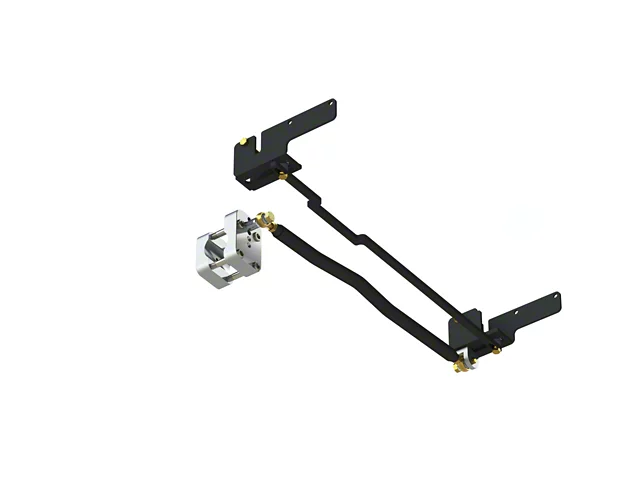
![]() A Watts link works by constraining the rear axle to vertical-only movement through a three-component linkage system. Two equal-length horizontal arms connect the chassis to a central rotating pivot (called a bellcrank) that bolts to the rear axle housing, creating a geometry that cancels out lateral motion entirely. Here's how those three components fit together:
A Watts link works by constraining the rear axle to vertical-only movement through a three-component linkage system. Two equal-length horizontal arms connect the chassis to a central rotating pivot (called a bellcrank) that bolts to the rear axle housing, creating a geometry that cancels out lateral motion entirely. Here's how those three components fit together:
1. Two Horizontal Arms (Links)
A pair of equal-length rods extend horizontally from the left and right sides of the chassis. Each arm attaches to the car's body or frame on one end, and to the bellcrank on the other. These arms are the same length by design, which is what gives the system its symmetrical behavior. As the suspension compresses or extends, the arms swing through opposing arcs that cancel each other out at the center pivot.
2. The Bellcrank (Central Pivot)
The bellcrank is the heart of the Watts link. It's a vertically oriented bracket bolted directly to the center of the rear axle housing. The two horizontal arms attach to the top and bottom of the bellcrank, creating a pivot point. As the car's body moves up and down relative to the axle (over bumps, during cornering, under hard braking), the bellcrank rotates in place while the arms pull against each other in equal and opposite directions.
3. The Geometry in Action
Because both arms are the same length and connect to opposite sides of the bellcrank, any lateral pull from one arm is immediately countered by the other. The result is that the pivot point on the axle traces a nearly perfect vertical line. Compare this to a panhard bar, where the single rod forces the axle to follow an arc, and you can see why a Watts link delivers more precise axle control.
Think of it this way: if you compress the suspension on one side (like when you dive into a corner), the bellcrank rotates, but the axle stays centered under the car. There's no lateral displacement, no pendulum effect, and no handling bias toward one side. The axle goes up, the axle goes down, and it stays planted right where it belongs. 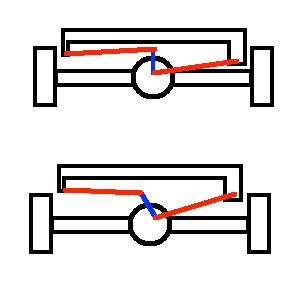
Watts Link vs. Panhard Bar
![]() A Watts link and a panhard bar both serve the same fundamental purpose (lateral axle location), but they accomplish it with different geometry. A panhard bar uses a single rod that forces the axle through a slight arc during travel, while a Watts link uses a symmetrical three-point linkage that keeps the axle on a vertical path with near-zero lateral shift.
A Watts link and a panhard bar both serve the same fundamental purpose (lateral axle location), but they accomplish it with different geometry. A panhard bar uses a single rod that forces the axle through a slight arc during travel, while a Watts link uses a symmetrical three-point linkage that keeps the axle on a vertical path with near-zero lateral shift.
How a Panhard Bar Works
A panhard bar (also called a track bar) is the simpler of the two designs. It's a single rigid rod that bolts to the chassis on one side and to the rear axle on the other. It's affordable, lightweight, and effective enough for most street driving, which is why Ford used them as original equipment on 2005-2014 Mustangs.
The trade-off is geometry. Because the panhard bar is a fixed-length rod mounted at an angle, the axle doesn't travel in a perfectly vertical line as the suspension compresses and extends. Instead, it follows a slight arc, like a clock pendulum swinging left and right. At full suspension travel, this arc can produce 5-10mm of lateral axle displacement, shifting the entire rear end slightly off center. On a smooth highway, you'll never notice it. On a track with aggressive weight transfer, curbing, and rapid direction changes, that lateral shift translates into inconsistent handling from side to side.
For a deeper dive into how panhard bars work and which ones fit your Mustang, check out our guide on everything about Mustang panhard bars. 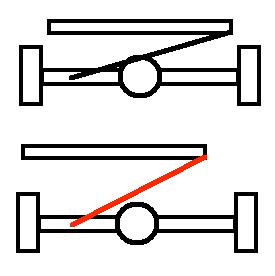
How a Watts Link Eliminates Lateral Shift
A Watts link solves the panhard bar's arc problem with symmetry. Because the two arms are equal in length and connect to a central pivot on the axle, any lateral pull from one arm is canceled by the other. The axle tracks vertically with near-zero lateral movement, even at full compression or extension. That means your Mustang corners the same going left as it does going right, with no geometric bias built into the suspension.
Side-by-Side Comparison
| Feature |
Watts Link |
Panhard Bar |
| Lateral axle movement |
Near zero |
5-10mm at full travel |
| Typical cost |
$600-$1,400 |
$150-$400 |
| Complexity |
Higher (3 links + bellcrank) |
Lower (1 rod + 2 mounts) |
| Roll center tunability |
Excellent (adjustable bellcrank height) |
Limited (fixed mounting points) |
| Weight |
Heavier (more components) |
Lighter (single bar) |
| Best for |
Track, autocross, and aggressive street builds |
Street driving and budget builds |
Addressing the Counterargument
Some suspension manufacturers argue that the 5-10mm of lateral shift from a high-quality panhard bar is negligible, pointing out that a tire's sidewall deflects more than that under cornering load. That's a fair point for daily driving and mild spirited runs. On a smooth road at moderate speeds, the difference between a Watts link and a well-made panhard bar is difficult to feel.
Where the Watts link pulls ahead is under sustained, high-load conditions: aggressive autocross, road course lapping, and driving over curbing or uneven surfaces at speed. In those scenarios, eliminating even a few millimeters of lateral movement adds up to more consistent tire contact patches, more predictable weight transfer, and a rear end that responds the same no matter which direction you turn. If you're pushing your Mustang hard enough to feel the difference, the Watts link is the better tool for the job. If your Mustang sees mostly street duty, a quality panhard bar will serve you well at a fraction of the cost.
Benefits of a Watts Link
![]() The main benefits of a Watts link are improved cornering stability, symmetrical left-to-right handling, a more tunable roll center, and better rear-end composure over bumps. These advantages compound with other suspension upgrades to transform how your Mustang handles.
The main benefits of a Watts link are improved cornering stability, symmetrical left-to-right handling, a more tunable roll center, and better rear-end composure over bumps. These advantages compound with other suspension upgrades to transform how your Mustang handles.
Improved Cornering Stability and Predictability
With the rear axle locked into vertical-only travel, your Mustang's rear tires maintain a more consistent contact patch through corners. The result is more grip, more confidence, and more predictable handling at the limit. You can push harder into turns knowing the rear end will stay planted rather than shifting laterally and upsetting the car's balance.
Symmetrical Handling in Left and Right Turns
Because of its equal-length arm design, a Watts link delivers identical geometry in both directions. There's no built-in handling bias, no "good side" and "bad side" in corners. For autocross and road course driving, where you're constantly switching directions, this symmetry is a major advantage over a panhard bar setup.
Better Performance Over Bumps and Uneven Surfaces
When your Mustang hits a bump mid-corner, the suspension compresses quickly and then rebounds. A panhard bar allows the axle to shift laterally during that rapid movement, which can upset the car's balance. A Watts link keeps the axle centered through the entire stroke, so bumps don't translate into lateral instability. This is especially noticeable on rougher track surfaces and over curbing.
Tunable Roll Center Height
Many aftermarket Watts link kits allow you to adjust the bellcrank's mounting position on the rear axle, which directly changes the roll center height. The roll center is the imaginary point around which the car's body rolls during cornering. Raising or lowering it changes how weight transfers and how the car responds to steering input. This tunability lets you dial in the rear suspension behavior to match your driving style, tire setup, and the rest of your suspension handling kit.
Reduced "Squirrelly" Rear-End Feel
That vague, unsettled sensation in the rear end during lane changes, highway sweepers, or mid-corner bumps often comes from the axle shifting laterally. A Watts link addresses that root cause directly, giving the rear end a more planted, confidence-inspiring feel that's immediately noticeable from the driver's seat.
Should You Install a Watts Link on Your Mustang?
![]() A Watts link makes sense for any Mustang build where rear-end stability and cornering precision are priorities, especially track, autocross, and aggressive street setups. For casual daily driving, a panhard bar is typically sufficient and easier on the budget. Here's how to think about it based on your build type:
A Watts link makes sense for any Mustang build where rear-end stability and cornering precision are priorities, especially track, autocross, and aggressive street setups. For casual daily driving, a panhard bar is typically sufficient and easier on the budget. Here's how to think about it based on your build type:
Track and Autocross Builds
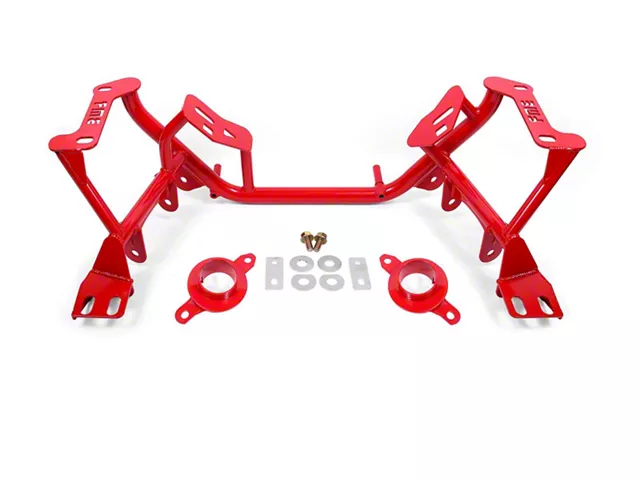
If you're lapping a road course or running autocross, a Watts link is one of the most impactful rear suspension upgrades you can make. The symmetrical handling, consistent contact patches, and bump composure all add up to faster, more consistent lap times. Pair it with adjustable control arms, quality subframe connectors, and a good set of sway bars for a complete rear suspension package.
Drag Racing Builds
Even on a straight-line car, a Watts link has value. During hard launches and aggressive shifts, the rear suspension cycles rapidly, and a panhard bar allows the axle to shift laterally during those transitions. A Watts link keeps the rear end tracking straight, which can improve consistency and prevent the car from stepping sideways under power. If you're building a dedicated drag car, explore the differences between setting up for drag racing vs. road courses to make sure every component works together.
Aggressive Street Builds
If your Mustang sees spirited backroad driving, occasional track days, and maybe a few autocross events per year, a Watts link is a solid investment. You'll notice the difference on uneven pavement, highway on-ramps, and any corner you take with enthusiasm. The key is making sure the rest of your suspension matches. A Watts link on stock springs and shocks won't deliver its full potential.
Casual Daily Driving
For a Mustang that mostly commutes and cruises, a quality panhard bar handles the job just fine. The lateral shift at normal driving loads is minimal, and you'll save several hundred dollars that could go toward other upgrades. If your Mustang already came with a factory panhard bar (2005-2014 models), you may not need to change anything for street-only use.
Fitment by Generation
Which Mustang generations work with a Watts link? Here's what you need to know:
- 1979-2004 (Fox Body, SN95, New Edge): These Mustangs did not come with a panhard bar from the factory. The rear axle is located by the upper and lower control arms alone, and adding a Watts link kit is a meaningful upgrade for any build. If you're working on a Fox Body specifically, check out our guide to Foxbody suspension upgrades for the full picture.
- 2005-2014 (S197): These models came from the factory with a panhard bar, which makes them strong candidates for a Watts link upgrade. Aftermarket Watts link kits are designed as direct replacements for the OEM panhard bar, so installation is relatively straightforward.
Cost and Value
Watts link kits for Mustangs generally fall in the $600-$1,400 range depending on the manufacturer and materials (steel vs. chromoly vs. aluminum components). That's a significant step up from a $150-$400 panhard bar. The question is whether your driving demands justify the price difference. If you're regularly at the track or building a serious performance car, the answer is almost always yes. If your Mustang stays on the street, the panhard bar delivers excellent value for the money.
Remember that a Watts link works best as part of a complete suspension strategy. Pairing it with control arms, sway bars, subframe connectors, and quality coilovers or shocks will give you the biggest handling gains. A Watts link on an otherwise stock suspension will still improve lateral stability, but you won't realize its full potential until the rest of the system is upgraded to match.
Practical Takeaways
- If you track your Mustang or autocross regularly, upgrade from the factory panhard bar to a Watts link before your next event — the symmetrical handling and bump composure will make a noticeable difference in lap times and driver confidence.
- Budget around $600-$1,400 for an aftermarket Watts link kit. Pair it with upgraded control arms, subframe connectors, and quality shocks or coilovers to get the most out of the upgrade.
- For street-only Mustangs, invest in a quality adjustable panhard bar first. The handling improvement per dollar is excellent, and you can always upgrade to a Watts link later if your driving demands increase.
- When choosing a Watts link kit, look for one with adjustable bellcrank height so you can tune your rear roll center to match the rest of your suspension setup.
- 1979-2004 Mustangs benefit the most from adding a Watts link since they lack a panhard bar from the factory. 2005-2014 models already have a panhard bar, making the Watts link swap straightforward.
Conclusion
![]() A Watts link is one of the most effective rear suspension upgrades for any solid-axle Mustang build focused on handling. By eliminating lateral axle shift and delivering perfectly symmetrical geometry, it transforms how the rear end behaves under cornering, over bumps, and during hard launches. Whether you're building a dedicated track car or simply want a more planted feel on spirited backroad drives, understanding how a Watts link works helps you make the smartest upgrade decision for your Mustang.
A Watts link is one of the most effective rear suspension upgrades for any solid-axle Mustang build focused on handling. By eliminating lateral axle shift and delivering perfectly symmetrical geometry, it transforms how the rear end behaves under cornering, over bumps, and during hard launches. Whether you're building a dedicated track car or simply want a more planted feel on spirited backroad drives, understanding how a Watts link works helps you make the smartest upgrade decision for your Mustang.
Ready to tighten up your Mustang's rear end and take your handling to the next level? Explore our full selection of panhard bars and suspension handling kits to find the right setup for your build and your budget.
Frequently Asked Questions About Watts Links
Below are the most common questions enthusiasts ask about Watts links, panhard bars, and rear suspension upgrades for their Mustangs.
What Does a Watts Link Do?
A Watts link keeps your rear axle centered under the car during suspension travel by using two horizontal arms and a central pivot. Unlike a panhard bar, which forces the axle to swing in an arc, a Watts link constrains the axle to move only vertically, eliminating lateral shift for more predictable handling through corners and over bumps.
What Is the Difference Between a Watts Link and a Panhard Bar?
A panhard bar uses a single diagonal rod to locate the rear axle, which causes slight lateral movement as the suspension cycles. A Watts link uses two equal-length arms connected to a central pivot, keeping the axle perfectly centered with zero side-to-side shift. The Watts link offers superior handling precision but costs more and is more complex to install.
Is a Watts Link Better Than a Panhard Bar?
For track-focused or aggressive cornering builds, a Watts link provides measurably better lateral axle control and more predictable handling. For daily drivers or budget builds, a quality adjustable panhard bar handles most driving situations well at a lower cost. The best choice depends on your driving style, budget, and how aggressively you corner.
How Does a Watts Link Work?
A Watts link connects to the chassis with two equal-length horizontal rods attached to a central pivot mounted on the rear axle. As the suspension travels up and down, the pivot rotates and the arms sweep in equal, opposite arcs, canceling lateral movement. The result is that the axle tracks straight up and down instead of swinging side to side.
Do I Need a Watts Link on My Mustang?
If you regularly autocross, road race, or push your Mustang hard through corners, a Watts link is a worthwhile upgrade that delivers noticeably more planted rear-end behavior. For street-only driving, an adjustable panhard bar paired with upgraded control arms and sway bars provides strong handling improvement at lower cost.
How Much Does a Watts Link Cost?
Aftermarket Watts link kits for Mustangs typically range from $600 to $1,400 depending on the manufacturer, materials, and whether bushings or rod ends are used. Installation adds additional cost if you are not doing the work yourself. By comparison, a quality adjustable panhard bar typically costs $150 to $400.
Can You Install a Watts Link on a Stock Mustang?
Yes, bolt-on Watts link kits are available for several Mustang generations. Most kits replace the factory panhard bar on 2005-2014 Mustangs or add lateral axle location to 1979-2004 Mustangs that lack a panhard bar from the factory. Installation typically requires basic hand tools and an afternoon in the garage.