Your Mustang is making decent power from the factory — but what if it could make more? Whether you just bolted on your first cold air intake or you are planning a full supercharger build, tuning is the single modification that ties everything together. In this guide, you will learn what Mustang tuning actually does under the hood, which mods require a recalibration, how to choose between canned, custom, and dyno tunes, and how tuning differs across every Mustang generation from Fox Body to S650. You will also get a side-by-side comparison of the top tuner brands so you can pick the right platform for your build.
What Is Mustang Tuning?
![]()
You just bolted on a cold air intake and a cat-back exhaust, fired up the engine, and it sounds incredible — but is your Mustang actually making more power? Without a tune, those bolt-ons are only doing half their job. So what exactly does tuning do, and why does every serious Mustang build start (or end) with one?
Mustang tuning is the process of reprogramming your car's ECU (Engine Control Unit) — the onboard computer that manages how much fuel to inject, when to fire the spark plugs, how aggressively the transmission shifts, and dozens of other parameters. The factory calibration is designed to balance fuel economy, emissions compliance, and broad reliability across varying fuel qualities and driving conditions. A performance tune replaces that conservative calibration with one optimized for maximum power, throttle response, or a specific combination of aftermarket parts.
Tuning adjusts parameters including air/fuel ratio (AFR) — the ratio of air to fuel in the combustion mixture, where stoichiometric is 14.7:1 for gasoline and performance tunes often target 12.5–13.0:1 at wide-open throttle — ignition timing advance (degrees BTDC), which controls how far before top dead center the spark fires; advancing timing increases power output up to the knock threshold, variable cam timing (VCT) tables, transmission shift points and firmness, rev limiter thresholds, and speed limiter removal. On turbocharged and supercharged Mustangs, tuning also controls boost pressure targets, wastegate duty cycles, and charge air temperature limits.
The tune is delivered via a handheld tuner (also called a programmer or flash tool) that plugs into your Mustang's OBD-II diagnostic port — the same port a mechanic uses to read check engine codes. The tuner reads your stock calibration, saves a backup, and then writes the new calibration to the ECU. The entire process typically takes 5-15 minutes.
Benefits of Tuning Your Mustang
![]()
A properly calibrated tune does more than just add horsepower — it transforms how your Mustang drives from cold start to redline. Here is what you can expect.
On a naturally aspirated Mustang GT with basic bolt-ons like a cold air intake and cat-back exhaust, a tune typically adds 15-30 horsepower and 15-25 lb-ft of torque at the wheels. On a supercharged or turbocharged Mustang, the gains are significantly larger — 40-80+ horsepower depending on the power adder and supporting modifications. Even on a completely stock Mustang, a tune can pick up 10-15 horsepower simply by removing the conservative factory calibration.
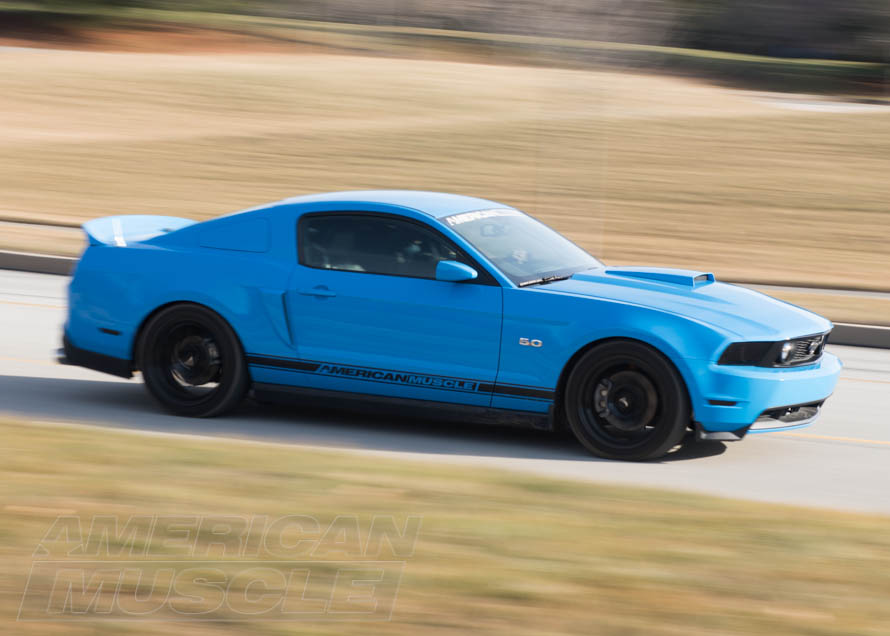
Beyond raw power numbers, tuning improves throttle response — eliminating the sluggish, delayed feeling many Mustang owners notice with the stock drive-by-wire calibration. Shift points on automatic-equipped cars become firmer and better timed, holding gears longer under wide-open throttle instead of short-shifting for fuel economy. Many owners report that a tune makes their Mustang feel like a completely different car.
Tuning also corrects the ECU's calibration after you install aftermarket parts. When you add a cold air intake with a different-sized MAF (Mass Air Flow) sensor housing, the factory calibration reads incorrect airflow values. A tune recalibrates the MAF transfer function so the ECU knows exactly how much air is entering the engine, which means correct fueling, proper timing, and no check engine lights.
Additional benefits include disabling the factory speed limiter (typically set at 112-155 mph depending on model year), raising the rev limiter for higher-RPM power on engines with supporting modifications, and optimizing cooling fan activation temperatures so your fans kick on earlier during spirited driving or track sessions.
What Mods Require a Tune?
![]()
Not every modification needs a tune, but any part that changes how much air, fuel, or boost enters your engine — or how exhaust exits — should be accompanied by a recalibration. Here is a practical breakdown.
Modifications that require a tune:
- Cold air intakes with a different-sized MAF housing than stock
- Supercharger and turbo kits — always require a tune for safe boost management
- Fuel injector upgrades — the ECU needs new injector characterization data to deliver correct fuel volumes
- Long-tube headers — change exhaust backpressure and O2 sensor placement, causing check engine lights without a tune
- Off-road mid-pipes and catalytic converter deletes — require O2 sensor code elimination
- Throttle body upgrades — alter airflow characteristics the ECU must account for
- Camshaft swaps — significantly change VCT requirements and idle characteristics
- Nitrous oxide systems — require timing retard and fuel enrichment programming
Modifications that do not typically require a tune:
- Cat-back exhaust systems (no sensor changes)
- Axle-back exhaust systems
- Drop-in air filter replacements (same MAF housing size)
- Suspension components — lowering springs, coilovers, sway bars
- Wheels and tires (though tire size changes may benefit from a speedometer recalibration)
- Exterior and interior accessories
When planning a build, consider pairing your parts with a cold air intake and tuner combo kit — bundling the hardware and the calibration together saves money and ensures compatibility from the start.
What Tune Do I Need? A Decision Framework
![]()
With so many tuning options available, figuring out which tune matches your Mustang's build can feel overwhelming. Use the decision framework below to narrow your choice based on your modification level, fuel type, and how you drive.
| Modification Level |
Fuel Type |
Primary Use |
Recommended Tune Type |
| Stock or intake/exhaust only |
87-93 octane pump gas |
Daily driving / weekend cruising |
Canned tune (handheld tuner with pre-loaded calibrations) |
| Multiple bolt-ons (intake, exhaust, throttle body, injectors) |
91-93 octane pump gas |
Street performance / spirited driving |
Custom mail-order tune or canned tune matched to your mod list |
| Forced induction (supercharger or turbo) |
93 octane or E85 |
Street/strip performance |
Custom mail-order tune or dyno tune — required for safe boost calibration |
| Heavy modifications (cams, heads, stroker, built motor) |
Race fuel or E85 |
Track / drag racing / competition |
Dyno tune — precision calibration with real-time data logging |
| EcoBoost (stock turbo, bolt-ons) |
91-93 octane |
Daily performance |
Canned or custom mail-order tune with boost-specific calibration |
| EcoBoost (upgraded turbo, intercooler, fuel system) |
93 octane or E85 |
High-performance street/track |
Custom mail-order tune or dyno tune |
A general rule: if your Mustang runs pump gas and has fewer than three bolt-on modifications, a quality canned tune from a reputable brand handles the job well. Once you cross into forced induction, E85, or multiple interdependent modifications, investing in a custom tune file tailored to your exact combination is the smart move — it protects your engine and extracts every available horsepower.
Canned Tune vs. Custom Tune vs. Dyno Tune
![]()
Understanding the differences between tune types helps you choose the right calibration strategy for your Mustang's build level and budget.
A canned tune (also called a pre-loaded tune or shelf tune) is a calibration file pre-programmed into a handheld tuner. It is designed for common modification combinations — stock, bolt-on, or specific supercharger kits — and loads onto your ECU in minutes. Canned tunes offer solid performance gains with zero wait time. A custom mail-order tune is written by a professional tuner specifically for your car's exact modification list, fuel type, and driving goals. You typically email your mod list to the tuner, receive a calibration file, load it via your handheld device, and then exchange data logs so the tuner can refine the calibration remotely. A dyno tune is performed in person on a dynamometer, where a tuner makes real-time adjustments while monitoring your engine's output, air/fuel ratios, and knock sensor activity under load.
| Feature |
Canned Tune |
Custom Mail-Order Tune |
Dyno Tune |
| Cost |
Included with tuner purchase ($300-$500) |
$50-$150 per revision on top of tuner |
$400-$800+ per session |
| Turnaround |
Instant — pre-loaded on device |
1-5 business days per revision |
Same day (2-4 hour session) |
| Precision |
Good for common setups |
Very good — tailored to your mod list |
Best — calibrated under actual load |
| Best For |
Stock to light bolt-on builds |
Moderate to heavy bolt-ons, forced induction |
High-power builds, race cars, maximum optimization |
| Revisions |
Fixed calibration |
Multiple revisions based on data logs |
Adjusted in real time during session |
| Convenience |
Load at home in minutes |
Load at home, email logs for revisions |
Must visit a dyno shop in person |
For most Mustang owners running a cold air intake, exhaust, and maybe a throttle body on pump gas, a canned tune delivers excellent results right out of the box. When your modification list grows or you add a power adder, stepping up to a custom tune ensures every component works together safely. Dyno tuning is the gold standard for high-horsepower builds where the cost of getting the calibration wrong — detonation, lean conditions, or blown head gaskets — far outweighs the cost of the session.
Mustang Tuner Brands Compared
![]()
Choosing a tuner brand matters because the hardware determines which tune files you can load, how you interact with tuning software, and what level of support you receive. Here is how the major players compare for Mustang applications.
SCT (Superchips Custom Tuning) has been the dominant force in Ford tuning for over two decades. Their handheld devices — the SCT X4 and newer BDX — are the most widely supported platforms in the Mustang aftermarket. Nearly every professional Mustang tuner offers SCT-format custom tune files, which means you have the broadest selection of tuning partners. Bama Performance is AmericanMuscle's in-house tuning partner, offering free tunes for life with the purchase of a Bama-branded tuner. The Bama program uses SCT hardware, giving you access to the SCT platform's flexibility while adding unlimited custom tune revisions at no extra cost — a significant value for enthusiasts who plan to modify their car in stages. DiabloSport offers the inTune i3 and Trinity T2 platforms with a focus on touchscreen interfaces, on-device data monitoring, and pre-loaded performance tunes. Cobb Tuning centers on the Accessport platform with strong support for EcoBoost Mustangs, offering detailed monitoring and open-source-style mapping capabilities. HP Tuners takes a different approach as a laptop-based tuning suite aimed at experienced tuners who want granular control over every calibration parameter — it is professional-grade software rather than a plug-and-play handheld solution.
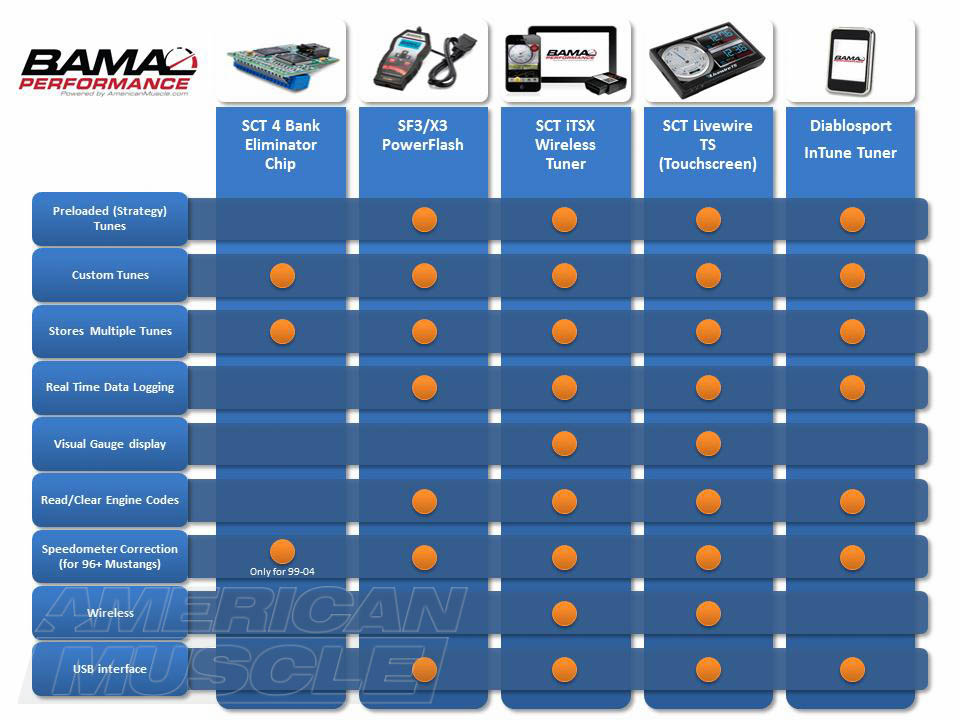
| Brand |
Popular Devices |
Custom Tune Support |
Best For |
Key Advantage |
| SCT |
X4, BDX |
Broadest third-party support |
All Mustang generations (1996+) |
Industry standard; most tuners write for SCT |
| Bama Performance |
SCT X4, BDX (Bama-branded) |
Unlimited free custom tunes for life |
Enthusiasts who modify in stages |
Free tunes for life with purchase |
| DiabloSport |
inTune i3, Trinity T2 |
DiabloSport-certified tuners |
Owners who want built-in data monitoring |
Touchscreen interface with live gauges |
| Cobb Tuning |
Accessport |
Cobb-certified ProTuners |
EcoBoost Mustang owners |
Strong EcoBoost support; detailed maps |
| HP Tuners |
MPVI2 + laptop software |
Self-tune or professional tuner |
Experienced tuners and shops |
Granular parameter control; pro-grade |
For a deeper look at the hardware differences between tuner platforms, check out our tuner types comparison guide. If you are ready to browse the full selection, head to our Ford Mustang tuners category.
Tuning by Mustang Generation
![]()
Every Mustang generation uses different engine management technology, which means the tuning hardware, methods, and available gains vary significantly from one platform to the next. Here is what you need to know about tuning your specific car.
Fox Body (1979-1993)
The Fox Body Mustang is where modern aftermarket Mustang tuning began. Early carbureted Fox Bodies (1979-1985) are tuned the old-fashioned way — by swapping jets, adjusting timing with a distributor wrench, and dialing in the carburetor. The real revolution came with the EEC-IV (Electronic Engine Control IV) system on 1986-1993 fuel-injected 5.0L cars.
Fox Body tuning uses chip-based calibration rather than OBD-II flash tuning. A tuning chip — like the SCT 4-Bank Eliminator — physically replaces the stock chip in the ECU and can store up to four different calibration files selectable via a switch. This lets you flip between a conservative daily tune, an aggressive 93-octane tune, and a race fuel tune without pulling the chip.
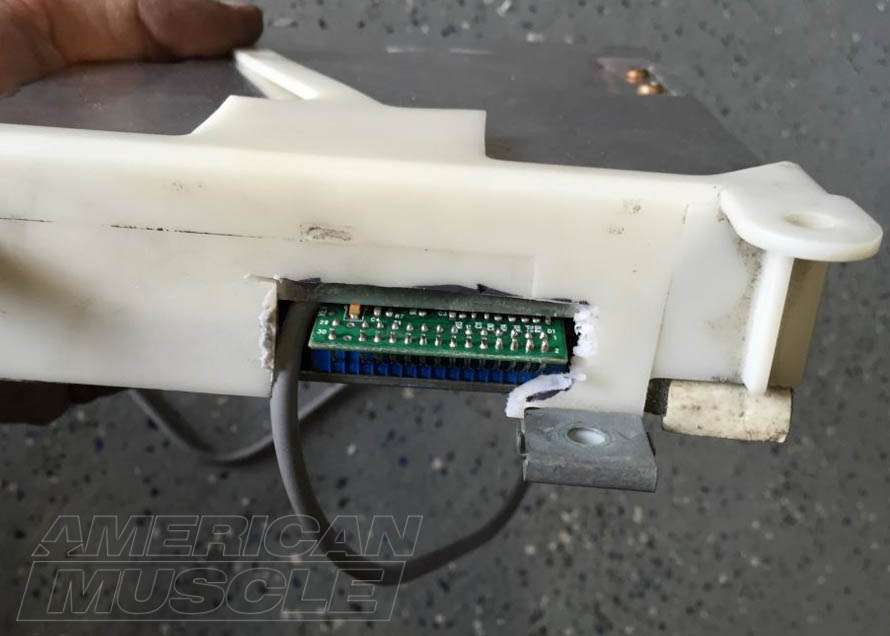
Common Fox Body tuning targets include adjusting the fuel injector slope and offset for upgraded 24 lb/hr or 30 lb/hr injectors, increasing timing advance from the conservative factory 10-degrees base to 12-14 degrees on high-octane fuel, raising the rev limiter beyond the stock 6,250 RPM ceiling, and recalibrating the MAF transfer function for aftermarket mass air meters. Browse Fox Body Mustang tuners to find the right chip for your 5.0. For a complete history of this platform, check out our guide to everything about the Fox Body Mustang.
SN95 (1994-1998)
The SN95 generation introduced Ford's EEC-V (Electronic Engine Control V) system, which moved Mustang tuning into the OBD-II era. This meant the tuning chip approach gave way to flash tuning through the OBD-II port — a far more convenient method that did not require opening the ECU housing.
The 1994-1995 SN95 carries the pushrod 5.0L, while the 1996-1998 models run the 4.6L SOHC Modular V8. Tuning the Modular engine focuses on optimizing the two-valve SOHC cam timing, refining the electronic throttle body (a new feature for Ford at the time), and adjusting for common bolt-ons like off-road H-pipes and cold air kits. Gains from a tune on a bolt-on SN95 GT typically range from 15-25 horsepower at the wheels.
New Edge (1999-2004)
The New Edge Mustang continued with the EEC-V platform on 1999-2004 GTs (4.6L 2V SOHC), and introduced the legendary 4.6L DOHC "Terminator" supercharged engine in the 2003-2004 SVT Cobra. Tuning the Terminator Cobra is one of the most rewarding Mustang tuning experiences — the factory Eaton M112 supercharger responds aggressively to a tune, and many owners see 30-50+ horsepower gains from tuning alone by increasing boost targets and optimizing fueling.
For naturally aspirated New Edge GTs, the tuning approach mirrors the SN95 — OBD-II flash tuning for intake, exhaust, and fuel system modifications. The 2001+ cars added an updated PCM that offered slightly more tuning flexibility in areas like VCT control.
S197 (2005-2014)
The S197 generation brought massive changes for Mustang tuning. The 2005-2010 Mustang GT runs the 4.6L 3-valve (3V) Modular V8 with Ford's first-generation variable cam timing (VCT), which gives tuners significantly more parameters to optimize. The 2011-2014 Mustang GT upgraded to the 5.0L Coyote DOHC V8 with Twin Independent Variable Cam Timing (Ti-VCT) — a tuner's dream with four independently adjustable cam phasers.
The Coyote engine's Ti-VCT system means a skilled tuner can optimize cam timing across the entire RPM range rather than using a single fixed advance. This is one reason the 2011+ Coyote responds so well to tuning, with bolt-on + tune combinations regularly producing 30-40+ horsepower gains at the wheels. The S197 also saw a wave of centrifugal and positive-displacement supercharger kits, all of which require tuning for safe and effective operation.
S550 (2015-2023)
The S550 Mustang represents the most tuner-friendly platform Ford has produced. The Gen 2 and Gen 3 Coyote engines (2015-2017 and 2018-2023 respectively) feature advanced Ti-VCT, direct injection (2018+), and highly capable PCMs with extensive calibration tables.
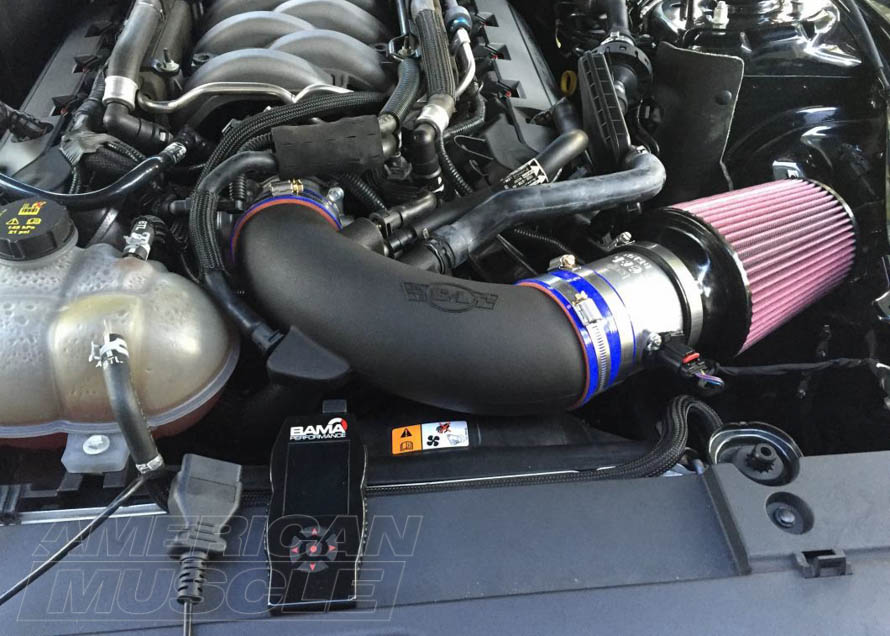
A notable tuning consideration for 2018+ S550 GTs: the Gen 3 Coyote's dual fuel system (port and direct injection) adds complexity to the calibration. Tuners must account for both injection systems when adjusting fueling, which is why custom tunes from experienced Coyote tuners are especially important on these cars.
The S550 is also the first Mustang GT to offer the 2.3L EcoBoost four-cylinder as a platform option, bringing turbocharged tuning into the mainstream Mustang world (more on that below). Browse 2015-2023 Mustang tuners for your specific S550 application.
S650 (2024+)
The S650 Mustang carries a revised Coyote V8 and an updated EcoBoost, both with new PCM encryption that initially limited tuning availability at launch. As of 2025, the major tuning platforms — SCT, HP Tuners, and others — have cracked the S650 calibration and now offer both canned and custom tune support.
The S650's Gen 4 Coyote features revised intake and exhaust cam profiles, an updated dual-injection fueling strategy, and a new 10-speed automatic transmission calibration. Early tuning results on the S650 GT are promising, with bolt-on combinations producing gains similar to the late S550 platform. If you are planning modifications for an S650, confirm that your tuner hardware supports the latest model year before purchasing — firmware updates may be required.
Tuning Your Mustang's EcoBoost
![]()
The 2.3L EcoBoost Mustang has become one of the most popular tuning platforms in the Mustang lineup, and for good reason — turbocharged engines respond dramatically to tuning because the tune controls boost pressure, which directly determines how much power the engine makes.
A stock EcoBoost Mustang produces around 310-330 horsepower (depending on model year). A simple tune on the stock turbo with no other modifications can push output to 340-360 horsepower by increasing boost targets, optimizing spark advance, and adjusting fueling. Add a performance intercooler, downpipe, and charge pipe kit, and a custom tune can push the stock turbo to 370-390 horsepower — a 20% gain over stock.
EcoBoost tuning introduces considerations that naturally aspirated Mustangs do not face. Intake air temperature (IAT) management is critical — turbocharged engines generate significant heat during compression, and a performance intercooler keeps charge temperatures low enough for the ECU to maintain aggressive timing and boost targets. Without adequate cooling, the ECU will pull timing and reduce boost to protect the engine, costing you the power you paid for.
Fuel quality matters more with boost. EcoBoost tunes are typically calibrated for 91 or 93 octane fuel. Running a 93-octane tune on 87-octane fuel risks detonation (knock) — uncontrolled combustion that can destroy pistons and bearings. Some tuners offer E30 or E85 blended fuel calibrations that take advantage of ethanol's higher octane rating and cooling properties to make significantly more power safely, but these require upgraded fuel injectors and a flex-fuel sensor.
For a deeper technical dive into boost management, read our guide on increasing boost on an EcoBoost Mustang.
How to Load a Tune on Your Mustang
![]()
Loading a tune onto your Mustang is straightforward regardless of which tuner platform you use. Here is the general process, step by step.
- Charge your battery. A stable battery voltage (at least 12.4 volts) is essential during the flash process. If voltage drops mid-flash, the ECU can be left in an incomplete state. Use a battery tender or charger connected during the process.
- Turn off all accessories. Turn off headlights, radio, climate control, and any aftermarket electronics. You want minimum electrical draw during the flash.
- Plug the tuner into the OBD-II port. The port is located under the dashboard on the driver's side, near the steering column. The tuner will power on and display a menu.
- Save your stock tune. Before loading any performance calibration, the tuner will prompt you to read and save your factory calibration file. This backup is critical — it is your return-to-stock option for warranty service, selling the car, or troubleshooting issues.
- Select and load the tune. Choose the appropriate calibration file — whether it is a pre-loaded canned tune matched to your octane and transmission type, or a custom file you have loaded onto the device from a tuner.
- Wait for the flash to complete. The tuner will write the new calibration to the ECU. This typically takes 5-15 minutes depending on the platform. Do not turn the key, disconnect the tuner, or start the engine during this process.
- Start the engine and let it idle. After the flash completes, start the car and let it idle for several minutes. The ECU needs to relearn idle parameters, fuel trims, and transmission adaptation values. Drive gently for the first 20-30 miles to allow full adaptation.
If you purchased a custom mail-order tune, your tuner may ask you to perform a data log after the initial flash — a recorded drive under specific conditions so the tuner can review your air/fuel ratios, timing, and knock activity. You will load revisions as the tuner refines the calibration based on your car's specific behavior.
Tuning and Your Mustang's Warranty
![]()
Warranty concerns are one of the most common reasons Mustang owners hesitate to tune their car. Here is what you need to know.
Under the Magnuson-Moss Warranty Act, a federal law governing consumer product warranties, a manufacturer cannot void your entire vehicle warranty simply because you installed aftermarket parts. However, the manufacturer can deny a specific warranty claim if they can demonstrate that the aftermarket modification caused or contributed to the failure being claimed. In practice, this means Ford can deny an engine warranty claim if they detect a tune and determine it contributed to the failure, but they cannot deny a warranty claim on your air conditioning system because you installed a tuner.
Most modern Ford dealerships use diagnostic scanning tools that can detect whether the ECU has been reflashed. While returning to the stock calibration before a dealer visit removes the active tune, some PCMs retain flash counter evidence that a reflash occurred. The detection capabilities vary by model year and dealership, so there is no universal guarantee that returning to stock will fully mask tuning history.
Practical reality: thousands of Mustang owners tune their cars and continue to receive warranty service on unrelated components without issue. If you are concerned about warranty coverage, consider these approaches:
- Return to stock before any dealer service — your tuner stores the factory calibration for exactly this reason
- Time your modifications — many owners wait until the powertrain warranty period ends before tuning
- Keep records — document your maintenance schedule and use quality parts to show you have maintained the vehicle responsibly
- Understand your risk tolerance — evaluate whether the performance gains outweigh the potential warranty implications for your situation
Practical Takeaways
![]()
Ready to get started? Here is where to focus based on where you are in your build:
- First-time tuner on a stock or lightly modified Mustang: Pick up a handheld tuner with canned tunes matched to your octane level and transmission type. A Bama-branded SCT device gives you free Tunes for Life, which means your calibration grows with your build at no extra cost.
- Multiple bolt-ons and ready for more: Step up to a custom mail-order tune. Send your tuner a complete mod list, fuel type, and driving goals — the calibration comes back tailored to your exact setup, and data log revisions dial it in further.
- Forced induction or heavy modifications: Invest in a dyno tune or work with an experienced remote tuner who specializes in your platform. Precision calibration protects your engine investment and extracts every available horsepower safely.
- EcoBoost owners: Prioritize a quality intercooler before or alongside your tune — charge air temperature management is the single biggest factor in maintaining consistent power on a turbocharged Mustang.
- Not sure where to start: Browse our Mustang tuners category to compare platforms, or check out the tuner types comparison guide for a deeper hardware breakdown.
Tuning your Mustang is one of the most impactful modifications you can make — whether you are chasing a few extra horsepower from a weekend cruiser or calibrating a full-build track car. The right tune unlocks the potential of every other modification on your car, and with today's handheld tuning technology, the process is more accessible than it has ever been. Explore AmericanMuscle's complete collection of Mustang tuners and performance chips to find the right platform for your build.