Why Change Your Mustang's Gear Ratio?
![]() Does your Mustang feel sluggish off the line, or are you wondering whether the rear gears in your car are actually holding back its potential? You are not alone — and you have come to the right place. A Mustang gear ratio swap is one of the most effective performance mods you can make, and this guide will walk you through how to identify your current ratio, choose the right one for your build, and understand the trade-offs between popular options like 3.55, 3.73, and 4.10 gears.
Does your Mustang feel sluggish off the line, or are you wondering whether the rear gears in your car are actually holding back its potential? You are not alone — and you have come to the right place. A Mustang gear ratio swap is one of the most effective performance mods you can make, and this guide will walk you through how to identify your current ratio, choose the right one for your build, and understand the trade-offs between popular options like 3.55, 3.73, and 4.10 gears.
Whether you own a Fox Body, an S197, or a brand-new S650, changing the ring and pinion gears in your rear differential directly affects how your engine's power reaches the wheels — giving you noticeably harder acceleration off the line, a more responsive throttle, and a car that genuinely feels faster without adding a single horsepower.
Here is the basic trade-off: gear ratios control the relationship between engine RPM and wheel speed. A numerically higher ratio (like 3.73:1 or 4.10:1) multiplies torque more aggressively, giving you stronger acceleration but a lower theoretical top speed. A numerically lower ratio (like 2.73:1 or 3.08:1) lets the engine cruise at lower RPMs for better highway fuel economy and higher top speed, but sacrifices that seat-of-the-pants launch feel.
Most Mustang owners are chasing harder pulls off the line and quicker ET times at the strip. If that sounds like you, swapping to a steeper set of Mustang rear end gears is one of the smartest first mods you can make. It does not add power, but it reshapes how your existing power is delivered, and the difference is immediately noticeable from the driver's seat. 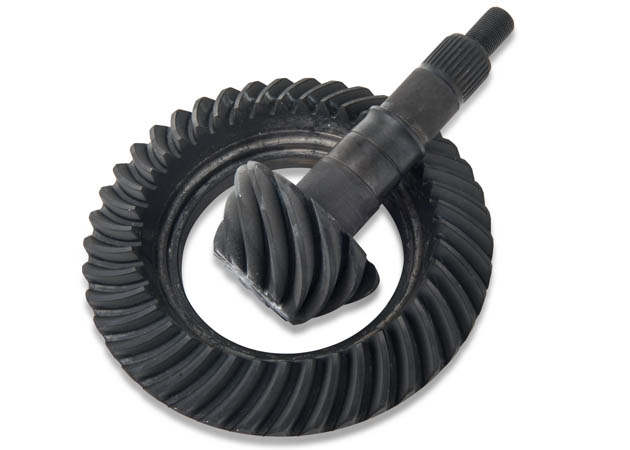
What Is a Gear Ratio and How Does It Work?
![]() A gear ratio is the relationship between the number of teeth on the ring gear and the number of teeth on the pinion gear inside your Mustang's rear differential. It tells you how many times the driveshaft must rotate to turn the rear wheels one full revolution.
A gear ratio is the relationship between the number of teeth on the ring gear and the number of teeth on the pinion gear inside your Mustang's rear differential. It tells you how many times the driveshaft must rotate to turn the rear wheels one full revolution.
For example, a 3.73:1 ratio means the driveshaft spins 3.73 times for every single rotation of the rear axles. A 3.08:1 ratio means the driveshaft only needs to spin 3.08 times. The higher that first number, the more mechanical advantage (torque multiplication) the gears provide, and the harder your car launches.
A Real-World RPM Example
Say your Mustang currently has a 3.31:1 axle ratio and cruises at 40 MPH with the engine turning 3,300 RPM. If you swap to 3.73:1 gears, the engine now needs to spin at roughly 3,700 RPM to maintain that same 40 MPH. The engine enters its power band sooner at every speed, which is why the car feels so much quicker. The trade-off is that you are closer to redline at any given speed, which reduces your theoretical top end.
Swap to a taller 3.08:1 ratio instead, and that same 40 MPH only requires about 3,080 RPM. You have more headroom before redline, which translates to a higher top speed, but less aggressive off-the-line acceleration.

Stock Mustang Gear Ratios by Generation
![]() Factory Mustang gear ratios have ranged from 2.73:1 all the way to 3.73:1, depending on the generation, engine, transmission, and factory performance packages. Knowing what Ford installed from the factory is the starting point for deciding where you want to be.
Factory Mustang gear ratios have ranged from 2.73:1 all the way to 3.73:1, depending on the generation, engine, transmission, and factory performance packages. Knowing what Ford installed from the factory is the starting point for deciding where you want to be.
|
Generation
|
Years
|
Common Factory Ratios
|
Notes
|
|
Fox Body
|
1979-1993
|
2.73, 3.08, 3.27, 3.45
|
V8 manual typically came with 2.73; V8 auto often had 3.08 or 3.27
|
|
SN95 / New Edge
|
1994-2004
|
3.08, 3.27, 3.55
|
Mach 1 and SVT Cobra models came with 3.55
|
|
S197
|
2005-2014
|
3.15, 3.31, 3.55, 3.73
|
Track Pack and Boss 302 equipped with 3.73
|
|
S550
|
2015-2023
|
3.15, 3.31, 3.55, 3.73
|
Performance Pack 1: 3.55; Performance Pack 2 and GT350: 3.73
|
|
S650
|
2024+
|
3.15, 3.55, 3.73
|
Dark Horse and GT Performance Pack: 3.73
|
Notice that Ford has trended toward steeper factory ratios over the years. Early Fox Body V8s shipped with lazy 2.73 gears, which is why a gear swap was (and still is) one of the most popular mods for that generation. Modern S550 and S650 Mustangs with performance packages already come with 3.73s from the factory, so those owners are starting from a much better baseline.
How to Find Your Mustang's Current Gear Ratio
![]() Before you can choose a new gear ratio, you need to know what you are currently running. There are three reliable ways to identify your Mustang's factory axle ratio.
Before you can choose a new gear ratio, you need to know what you are currently running. There are three reliable ways to identify your Mustang's factory axle ratio.
Method 1: Door Jamb Certification Label
Open the driver's door and look at the certification label (also called the VC label) on the door jamb or door pillar. On many Mustangs, this label includes an axle code that corresponds to a specific gear ratio. You can cross-reference the two-character code against Ford's axle code charts, which are widely available online and in factory service manuals.
Method 2: Rear Axle Tag
Look at the rear differential housing itself. Most Ford rear ends have a small metal tag attached to one of the bolts on the differential cover or carrier. This tag typically lists the gear ratio directly (for example, "3.55" or "3.73"). If a previous owner swapped gears and did not replace the tag, this method may not be accurate.
Method 3: Count the Gear Teeth
If the tag is missing and the door jamb code is unclear, the definitive method is to pull the differential cover and count the teeth on the ring gear and pinion gear. Divide the ring gear tooth count by the pinion tooth count. For instance, 41 ring gear teeth divided by 11 pinion teeth equals 3.73:1. This method always gives you the true ratio, regardless of what tags or labels say.
You can also call a Ford dealer with your VIN, and they can look up the factory build sheet to confirm the original axle ratio. Keep in mind this only tells you what the car left the factory with, not what may have been swapped since then.
Choosing the Best Gear Ratio for Your Mustang
![]() There is no single best gear ratio for every Mustang. The right choice depends on three things: your transmission type, whether you are running forced induction, and how you actually drive the car. Here is a breakdown by setup.
There is no single best gear ratio for every Mustang. The right choice depends on three things: your transmission type, whether you are running forced induction, and how you actually drive the car. Here is a breakdown by setup.
Best Gear Ratio for Manual Transmission Mustangs
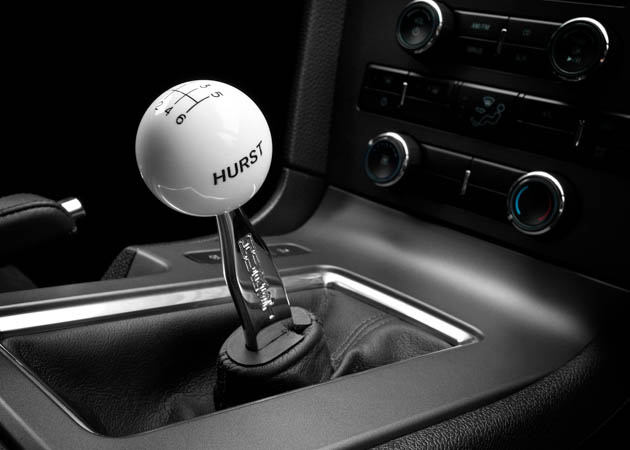
For manual transmission Mustangs, 3.73:1 is the gold standard. Decades of real-world experience from thousands of Mustang owners consistently confirm that 3.73s deliver the best balance of strong off-the-line acceleration and livable highway RPMs with a 5-speed or 6-speed manual.
Most factory manual Mustangs ship with ratios between 2.73 and 3.31 (depending on generation), so swapping to 3.73s gives you a significant and immediately noticeable improvement in throttle response and acceleration. You will feel the difference the first time you pull out of your driveway.
If 3.73s are not enough, the next step up is 4.10:1. However, 4.10 gears are genuinely steep with a manual transmission. Highway cruising RPMs climb noticeably, and the car can feel busy on the freeway. For a daily-driven manual Mustang, most owners find 3.73 to be the sweet spot. A 3.55:1 ratio is another solid option if you want a bit more gear than stock without going all the way to 3.73, though the performance difference between 3.55 and 3.73 is modest enough that most people simply go with 3.73.
When swapping gears on a manual car, you may also want to upgrade your Mustang clutch kits and Mustang flywheels if your current clutch is near the end of its life. Steeper gears put more load on the clutch, so it is a smart time to address both at once.
Best Gear Ratio for Automatic Transmission Mustangs
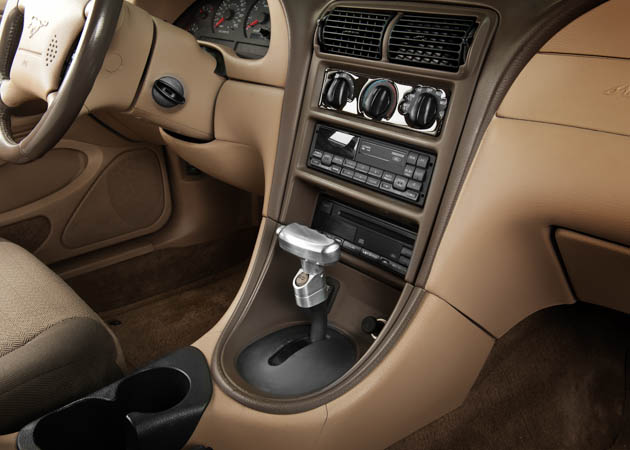
The gold standard for automatic Mustangs is 4.10:1. Automatic transmissions typically have numerically lower first gears than manuals, and the torque converter introduces some slip, so automatic cars benefit from a steeper differential ratio to compensate.
A set of 4.10 gears on an automatic Mustang transforms the driving experience. The car gets off the line harder, the transmission shifts more crisply, and the overall powerband feels much more responsive. For street and strip use, 4.10s hit the sweet spot. More race-oriented builds sometimes go as steep as 4.56:1, but for the vast majority of street-driven automatic Mustangs, 4.10 is the right answer.
If you are planning a gear swap on your automatic Mustang, consider inspecting your automatic transmission parts at the same time. A shift kit, upgraded torque converter, or transmission cooler can complement the new gears and make the whole drivetrain work together more effectively.
Best Gear Ratio for Supercharged or Turbocharged Mustangs
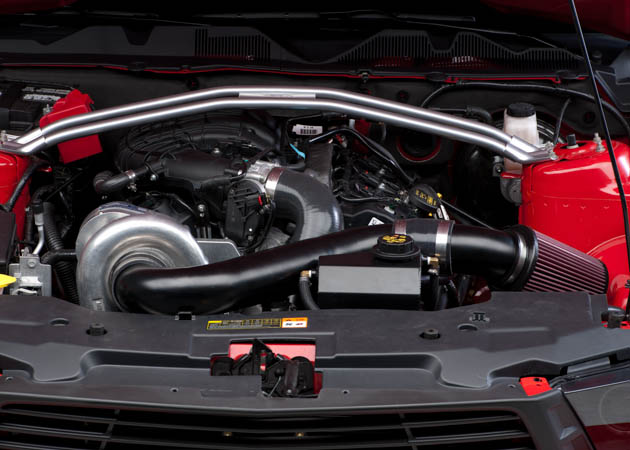
Forced induction changes the gear ratio equation significantly. A supercharged or turbocharged Mustang already has massive amounts of torque across the RPM band, so the engine does not need a steep gear to get moving. In fact, running too steep a ratio on a boosted car can cause excessive wheel spin and make the car harder to drive.
Most forced induction street Mustangs run between 3.08:1 and 3.27:1 rear gears. These milder ratios let the engine use its broad powerband effectively while still providing strong acceleration. You get the best of both worlds: killer performance off the line from the boost and respectable top-end speed because the gears are not revving the engine to redline at highway speeds.
If you are exploring forced induction options, check out our supercharger tech guide for a deeper look at how blowers and turbos interact with your entire drivetrain setup.
Mustang Gear Ratio Comparison: 3.55 vs 3.73 vs 4.10
![]() These three ratios are the most popular aftermarket choices for Mustang owners. Here is how they compare across the factors that matter most.
These three ratios are the most popular aftermarket choices for Mustang owners. Here is how they compare across the factors that matter most.
|
Factor
|
3.55:1
|
3.73:1
|
4.10:1
|
|
Acceleration
|
Moderate improvement over stock
|
Strong, noticeable improvement
|
Aggressive, very strong launch
|
|
Highway RPM (6th gear, 70 MPH)
|
Slightly elevated
|
Moderately elevated
|
Noticeably higher, engine works harder
|
|
Fuel Economy Impact
|
Minimal reduction
|
Slight reduction
|
Noticeable reduction
|
|
Best Transmission Pairing
|
Manual (daily/street focus)
|
Manual (street/strip)
|
Automatic (street/strip)
|
|
Best For
|
Daily drivers wanting a mild bump
|
Most manual Mustang builds
|
Automatic builds, drag-focused cars
|
|
Top Speed
|
Least affected
|
Slightly reduced
|
Most reduced
|

For the majority of naturally aspirated manual Mustangs, 3.73 is the ratio to beat. It provides a substantial improvement in acceleration over typical factory ratios without making the car unpleasant on the highway. If you drive a daily automatic, 4.10 is your move. And if you want a subtle upgrade that keeps highway cruising comfortable, 3.55 is a solid middle ground.
Understanding Mustang Differential Types
![]() Before swapping gears, it is worth understanding the differential your Mustang uses, because the differential type affects how your new gear ratio translates to traction at the wheels.
Before swapping gears, it is worth understanding the differential your Mustang uses, because the differential type affects how your new gear ratio translates to traction at the wheels.
Mustangs come with one of three differential types:
- Open differential: The most basic setup. Each wheel can spin independently, which means the wheel with the least traction gets all the power. This is why open-diff Mustangs are notorious for one-wheel burnouts.
- Limited-slip differential (LSD): When one wheel starts to slip, the LSD transfers torque to the opposite wheel to maintain traction. This is the most common factory upgrade on GT and performance-packaged Mustangs, and it is what most enthusiasts want for street and strip driving.
- Locking differential: Both wheels are locked together and spin at the same rate at all times. This is mostly found on dedicated drag or race builds because it delivers maximum traction but can make the car harder to turn on the street.
If you are running an open differential and planning a gear swap, seriously consider upgrading to a limited-slip unit at the same time. Steeper gears with an open diff just means a more aggressive one-tire fire. For a deeper dive, check out our guides on differential types explained and Mustang rear differential gears.
What to Do After Changing Your Gear Ratio
![]() After installing new gears, there are three things you need to do to make sure everything is dialed in and your Mustang is running right.
After installing new gears, there are three things you need to do to make sure everything is dialed in and your Mustang is running right.
- Recalibrate your speedometer. A gear ratio change throws off your speedometer reading because the wheel speed sensor is calibrated for the old ratio. For electronic speedometers (most 1994+ Mustangs), a handheld tuner or speedometer recalibration tool will fix this in minutes. Older Fox Body and SN95 cars with cable-driven speedometers need a new speedometer gear sized for the new ratio.
- Change the gear oil at 1,000 miles. New gears shed tiny metal particles as they break in. Draining and replacing the differential fluid at around 1,000 miles flushes those shavings out before they can cause premature wear. After that, follow normal maintenance intervals.
- Take a careful test drive. Before you push the car hard, drive it gently and listen for any unusual whining, clunking, or vibrations from the rear end. Properly set up gears should be quiet under all driving conditions. If something sounds off, have the gear mesh pattern checked before putting serious miles on the car.
For a step-by-step walkthrough of the installation itself, check out our gear installation guide.
How Aftermarket Wheels and Tires Affect Gear Ratios
![]() Aftermarket wheels and tires can change how your gear ratio feels, even if you have not touched the ring and pinion. The key factor is overall tire diameter (wheel diameter plus twice the tire sidewall height).
Aftermarket wheels and tires can change how your gear ratio feels, even if you have not touched the ring and pinion. The key factor is overall tire diameter (wheel diameter plus twice the tire sidewall height).
A taller tire effectively makes your gears feel numerically lower. The wheels require more force to turn, so acceleration decreases slightly and highway RPMs drop. Your car behaves as though it has a milder gear ratio than what is actually installed.
A shorter tire does the opposite. Smaller overall diameter means the wheels spin faster for the same driveshaft speed, making the gears feel steeper. Acceleration improves slightly, but highway RPMs increase.
This is important to keep in mind when choosing a gear ratio. If you are planning to run significantly larger or smaller tires than stock, factor the tire size change into your gear ratio decision. A Mustang running 315-width drag radials with a tall sidewall may need a slightly steeper gear to compensate for the increased tire diameter.
Signs of a Failing Rear Axle
![]() Whether or not you have recently swapped gears, keeping an eye (and ear) on your rear axle assembly is important. Catching problems early prevents expensive damage and keeps you safe. Watch for these warning signs:
Whether or not you have recently swapped gears, keeping an eye (and ear) on your rear axle assembly is important. Catching problems early prevents expensive damage and keeps you safe. Watch for these warning signs:
- Excessive vibration: Vibrations felt through the floor or seat, especially at certain speeds, can indicate worn axle bearings, an improperly set gear mesh, or a failing U-joint.
- Clunking or sputtering noises: Metallic clunking when shifting or changing throttle position often points to excessive backlash in the gears or worn differential components.
- Oil leaks near the wheels: Fluid pooling near the rear wheels or around the differential cover suggests a leaking axle seal, which can starve the gears of lubrication.
- Loss of power: If you step on the throttle and the engine revs without the car accelerating proportionally, you may have a failing differential or broken axle shaft.
If you notice any of these symptoms, inspect the rear end before driving further. Replacement Mustang axles and axle components are available for every generation.
Practical Takeaways
![]() Here is a quick-reference checklist to take with you as you plan your Mustang gear ratio upgrade:
Here is a quick-reference checklist to take with you as you plan your Mustang gear ratio upgrade:
- Identify your current ratio first. Check the door jamb certification label, the rear axle tag, or count the gear teeth before shopping for new gears.
- Match gears to your transmission type. Manual Mustangs: start with 3.73:1. Automatic Mustangs: start with 4.10:1. Forced induction builds: 3.08:1 to 3.27:1.
- Consider your differential type. Steeper gears paired with an open differential will just spin one tire harder. If you are upgrading gears, upgrade to a limited-slip differential at the same time.
- Budget for supporting parts. Plan for a speedometer recalibration tool or tuner, fresh gear oil for break-in, and potentially a new clutch or torque converter if yours is worn.
- Factor in tire size. Larger tires make gears feel milder; smaller tires make them feel steeper. If you are also changing wheel and tire sizes, account for the combined effect.
- Break in properly. Change the differential fluid at 1,000 miles and take a careful test drive before pushing the car hard.
- Confirm fitment before you order. Use AmericanMuscle's fitment tools to verify the right gear set, differential, and supporting parts for your specific Mustang year and model.
Ready to Upgrade Your Mustang's Gears?
![]() Choosing the right gear ratio is one of the smartest decisions you can make for your Mustang build. Whether you are chasing harder launches at the strip, optimizing a supercharged street car, or just looking for a more responsive daily driver, the right set of ring and pinion gears will transform how your car drives. Pair your new gears with the right differential, clutch, and supporting parts, and you will have a drivetrain that works together as a complete package.
Choosing the right gear ratio is one of the smartest decisions you can make for your Mustang build. Whether you are chasing harder launches at the strip, optimizing a supercharged street car, or just looking for a more responsive daily driver, the right set of ring and pinion gears will transform how your car drives. Pair your new gears with the right differential, clutch, and supporting parts, and you will have a drivetrain that works together as a complete package.
Explore the full lineup of Mustang drivetrain parts, including ring and pinion gear kits from trusted brands like Ford Performance, Motive Gear, Richmond, and USA Standard Gear — plus limited-slip differentials, axles, and everything else you need to get your rear end dialed in.
Frequently Asked Questions About Mustang Gear Ratios
Choosing the right gear ratio for your Mustang depends on your drivetrain setup, driving style, and performance goals. Here are the most common questions Mustang owners ask about rear end gears.
What Is the Factory Gear Ratio for a Mustang?
Factory Mustang gear ratios range from 2.73:1 to 3.73:1 depending on the model year, engine, and package options. Most modern GT Mustangs (2018-2023) come standard with 3.55:1 gears on automatics and 3.73:1 gears on manual transmissions. V6 and EcoBoost models typically ship with 3.15:1 or 3.31:1 ratios. Check your door jamb certification tag under the "AX" or "AXLE" code to confirm your specific ratio.
Are 3.73 or 4.10 Gears Better for a Mustang?
For most Mustang owners, 3.73 gears offer the best balance of acceleration and drivability for street and occasional strip use. The 4.10 ratio delivers noticeably harder acceleration off the line but raises highway RPMs and reduces fuel economy. Manual transmission Mustangs generally pair best with 3.73s, while automatic Mustangs benefit more from 4.10s because the torque converter absorbs some of the gear's mechanical advantage.
What Is the Best Gear Ratio for a Mustang GT?
The best gear ratio for a Mustang GT depends on your transmission type and how you drive. For manual GT owners who split time between street driving and occasional drag strip runs, 3.73:1 is the gold standard. Automatic GT owners typically prefer 4.10:1 for sharper throttle response. If your GT has a supercharger or turbo kit, a milder 3.08:1 or 3.27:1 ratio works best because forced induction already provides strong low-end torque.
Which Is Better, 3.55 or 3.73 Gears?
The difference between 3.55 and 3.73 gears is small but noticeable. A 3.55 ratio delivers slightly lower highway RPMs and marginally better fuel economy, making it a solid daily-driver choice. A 3.73 ratio provides a bit more off-the-line punch with only a modest increase in highway RPMs. Most Mustang owners who want both streetability and performance choose the 3.73, which is why Ford selected it as the Performance Pack gear for modern GT models.
How Do I Find My Mustang's Gear Ratio?
You can find your Mustang's gear ratio three ways: check the vehicle certification tag on the driver-side door jamb (look for the "AX" or "AXLE" code), look for the metal tag bolted to the differential cover, or count the ring and pinion gear teeth and divide the ring gear count by the pinion count. For 2005 and newer Mustangs, the door tag lists the ratio under "AXLE" with codes like BB (3.73), DD (3.55), or GG (3.31).
What Gear Ratio Should I Run With a Supercharger or Turbo?
Forced induction Mustangs benefit from a taller (numerically lower) gear ratio because the supercharger or turbo already produces massive torque across the RPM band. Most blown or turbocharged street Mustangs run between 3.08:1 and 3.27:1, which balances strong launch performance with excellent top-end speed. Running a steep gear like 3.73 or 4.10 on a forced-induction car can overwhelm the tires and shorten axle life.
Do I Need to Recalibrate My Speedometer After Changing Gears?
Yes — changing your rear gear ratio will make your speedometer read incorrectly. Pre-1999 Mustangs require a replacement speedometer drive gear matched to the new ratio. 1999 and newer Mustangs need an ECU flash or handheld tuner to recalibrate the speedometer electronically. Driving with an inaccurate speedometer affects safety and can lead to unintended speeding tickets, so this step should not be skipped.
How Do Aftermarket Wheels and Tires Affect My Gear Ratio?
Larger overall tire diameter makes your gears feel taller (numerically lower), reducing acceleration because the wheel requires more force to turn. Smaller tires make gears feel steeper and improve acceleration but reduce top speed. When upgrading to significantly larger or smaller tires, many owners adjust their gear ratio to compensate — a common pairing is 3.73 gears with a slightly taller tire to balance acceleration and highway comfort.